Beijing National Grand Theater (NCPA) tickets 15 March 2026 - The Red Sorghum | GoComGo.com

The Red Sorghum

Beijing National Grand Theater (NCPA), Opera House, Beijing, China
All photos (1)
Select date and time
2:30 PM
From
US$ 76

E-tickets: Print at home or at the box office of the event if so specified. You will find more information in your booking confirmation email.

You can only select the category, and not the exact seats.
If you order 2 or 3 tickets: your seats will be next to each other.
If you order 4 or more tickets: your seats will be next to each other, or, if this is not possible, we will provide a combination of groups of seats (at least in pairs, for example 2+2 or 2+3).

Important Info
Type: Opera
City: Beijing, China
Starts at: 14:30
Intervals: 1
Duration: 3h

E-tickets: Print at home or at the box office of the event if so specified. You will find more information in your booking confirmation email.

You can only select the category, and not the exact seats.
If you order 2 or 3 tickets: your seats will be next to each other.
If you order 4 or more tickets: your seats will be next to each other, or, if this is not possible, we will provide a combination of groups of seats (at least in pairs, for example 2+2 or 2+3).

Overview

The year 2025 marks the 80th anniversary of the victories of the Chinese People’s War of Resistance Against Japanese Aggression and World Anti-Fascist War.

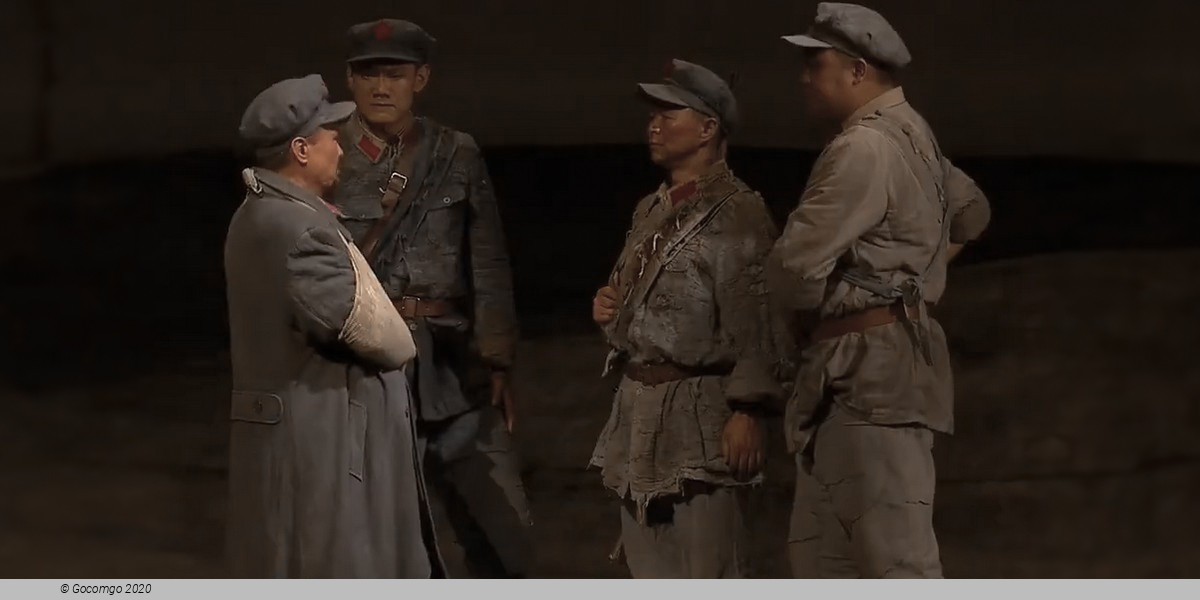
The NCPA national opera commission, The Red Sorghum, will have its premiere to carry forward the fine traditions of heroism and patriotism. Based on Red Sorghum Clan, a full-length novel by MO Yan, a winner of the Nobel Prize in Literature, the opera, set during the Chinese People’s War of Resistance against Japanese Aggression in Gaomi Town, Shandong Province, tells a legendary story about DAI Fenglian, YU Zhan’ao and other villagers. It depicts how the common people agonise over human nature in the old society and how they awaken with determination to fight when the nation is in peril. Since its publication, the novel has been adapted into multiple forms of art, such as film, TV drama, dance drama and Peking Opera, which are highly popular with the public.

Produced by a top-class creative team, the NCPA version will soon present this classic on the opera stage for the first time. Written personally by MO Yan, the original author, the libretto features impressive opera characters. During the creative process, GUO Wenjing, a famous composer, fully utilised the regional style and national character of the opera, composing it if it were a grand opera, thereby making the musical language both symphonic and dramatic. Directed by WANG Xiaodi, the opera will have its premiere under the baton of LÜ Jia, Music and Artistic Director of the NCPA. He will work with the creative team, including the set designer JI Qiao, costume designer CHEN Tongxun, lighting designer XING Xin and video projection designer HU Tianji, to tell this touching story set in the sorghum field to write an endless epic about the people.

Synopsis

Scene I

Jiu’er is forced by her father, DAI Laosan, who is greedy for money, to marry the owner of the SHAN’s Winery, who suffers from tuberculosis. On the wedding day, her lover, YU Zhan’ao, comes to carry the bridal sedan chair. On the way to the groom’s home, Jiu’er is harassed by a Japanese sergeant named Kameo. YU Zhan’ao steps forward bravely and kills Kameo. At this juncture, Staff Officer REN and the guerrilla fighters turn up and run into YU Zhan’ao. They disarm the puppet troops and take the long-barrel guns away. Jiu’er is rescued, but she is still compelled to return into the sedan chair and carried to the groom’s home.

Scene II

On the wedding night, SHAN Bianlang intentionally tried to match up LIU Luohan with his daughter-in-law Fengxian, but LIU Luohan, who has a deep love for Jiu’er, refuses to accept Fengxian. To cut off LIU Luohan’s attachment to Jiu’er, Fengxian puts knockout drops in the liquor for YU Zhan’ao, in the hope of helping her father-in-law SHAN Bianlang to consummate his marriage. Failing to have YU Zhan’ao come to rescue her, Jiu’er picks a pair of scissors up to defend herself. Seeing Jiu’er risk her life to resist him, SHAN Bianlang finally relinquishes his attempt to consummate the marriage that night.

Scene III

Three days later, Jiu’er returns to her parental home with her father DAI Laosan. When they walk by the sorghum fields, YU Zhan’ao, who is just waiting in ambush there, intercepts Jiu’er. After pouring out their hearts in the sorghum fields, they pledge to marry each other.

Scene IV

At the Double Ninth Festival, new liquor is made in the SHAN’s winery, where workers talk about rumours that Jiu’er is pregnant and YU Zhan’ao has been kidnapped by bandits. The winery flourishes under Jiu’er’s management. At this moment, YU Zhan'ao suddenly returns to the winery and publicly admittes that he was not the one who killed SHAN Bianlang, and SHAN Bianlang has actually died of anger upon learning that Jiu'er and YU Zhan'ao has a private engagement. He then declares his intention to stay at the winery to help Jiu’er.

Scene V

Seeing the love between YU Zhan’ao and Jiu’er, LIU Luohan makes a resolve to leave. Upon hearing that Luohan is leaving, Fengxian shows her love for him. At the moment, Luohan receives a message that the Japanese army is storming the winery to capture YU Zhan’ao. So he returns to the winery to cover YU Zhan’ao and Jiu’er. Fengxian gets shot while saving LIU Luohan, who is ultimately captured.

Scene VI

On the execution ground, LIU Luohan, who would rather die than surrender, bitterly rebukes the Japanese invaders. Japanese soldiers force DAI Laosan to flay LIU Luohan alive. Encouraged by LIU Luohan, DAI Laosan, who is timid, kills LIU with a thrust of the knife, sparing him from suffering torments. Then DAI Laosan rushes to the Japanese officer with the knife, only to be shot dead by Japanese soldiers.

Scene VII

Three years later, YU Zhan’ao sets an ambush on the bridge near the sorghum fields, with “jars of liquor piled up” for an attack on the Japanese forces. Staff Officer REN reports the Japanese army’s movements and deploys troops for a battle. He encourages them to fight for the national dignity and their deceased loved ones. YU Zhan’ao makes a firm decision that he will join the Eighth Route Army after the battle.

Scene VIII

In the village, Jiu’er is leading other women in preparing meals for the guerrilla fighters, while YU Zhan’ao and Staff Officer REN are working with others to blow up the Japanese military vehicles. On their way delivering meals, Jiu’er and Mrs. WANG see Japanese soldiers launching a sneak attack from the rear, so Jiu’er shouts loudly in the sorghum fields to alert the guerrillas. As the Japanese soldiers close in, Jiu’er risks her life to throw a grenade at them. Failing in the sneak attack, the Japanese soldiers shoot Jiu’er dead.

Venue Info

Beijing National Grand Theater (NCPA) - Beijing
Location   2 W Chang'an Ave

The National Centre for the Performing Arts (NCPA) is an arts centre containing an opera house in Beijing, People's Republic of China. The Centre, an ellipsoid dome of titanium and glass surrounded by an artificial lake, seats 5,452 people in three halls and is almost 12,000 m² in size. It was designed by French architect Paul Andreu. Construction started in December 2001 and the inaugural concert was held in December 2007.

The exterior of the theater is a titanium-accented glass dome that is completely surrounded by a man-made lake. It is said to look like an egg floating on water, or a water drop. It was designed as an iconic feature, something that would be immediately recognizable.

The dome measures 212 meters in east–west direction, 144 meters in north–south direction, and is 46 meters high. The main entrance is at the north side. Guests arrive in the building after walking through a hallway that goes underneath the lake. The titanium shell is broken by a glass curtain in north–south direction that gradually widens from top to bottom.

The location, immediately to the west of Tiananmen Square and the Great Hall of the People, and near the Forbidden City, combined with the theatre's futuristic design, created considerable controversy. Paul Andreu countered that although there is indeed value in ancient traditional Chinese architecture, Beijing must also include modern architecture, as the capital of the country and an international city of great importance. His design, with large open space, water, trees, was specially designed to complement the red walls of ancient buildings and the Great Hall of the People, in order to melt into the surroundings as opposed to standing out against them.

Internally, there are three major performance halls:

The Opera Hall is used for operas, ballet, and dances and seats 2,416 people.
The Music Hall is used for concerts and recitals and seats 2,017 people.
The Theatre Hall is used for plays and the Beijing opera. It has 1,040 seats.
The NCPA also distributes filmed and recorded performances of its concerts, plays and operas through the in-house label NCPA Classics, established in 2016.

The initial planned cost of the theatre was 2.688 billion yuan. When the construction had completed, the total cost rose to more than CNY3.2 billion. The major cause of the cost increase was a delay for reevaluation and subsequent minor changes as a precaution after a Paris airport terminal building collapsed. The cost has been a major source of controversy because many believed that it is nearly impossible to recover the investment. When the cost is averaged out, each seat is worth about half a million CNY. The Chinese government answered that the theater is not a for profit venture.

The government sanctioned study completed in 2004 by the Research Academy of Economic & Social Development of the Dongbei University of Finance and Economics, of the upkeep costs of the building were publicized in domestic Chinese media:

The water and electricity bills and the cleaning cost for the external surface would be at least tens of millions CNY, and with another maintenance cost, the total could easily exceed one billion CNY. Therefore, at least 80 percent of the annual operational costs must be subsidized by the government for at least the first three years after the opening, and for the rest of its operational life, at least 60 percent of the annual operational cost must be subsidized by the government.

The director of the art committee of the National Centre for the Performing Arts and the standing committee member of the Standing Committee of the Chinese People's Political Consultative Conference, Mr Wu Zuqiang (吴祖强) and the publicist / deputy director of the National Centre for the Performing Arts Mr Deng (邓一江) have announced that 70 percent of the tickets would be sold at low price for ordinary citizens, while 10% of the tickets would be sold at relatively expensive prices for separate market segments, and the 60% of annual operating cost needed to be subsidized by the government would be divided between the central government and the Beijing municipal government.

Important Info
Type: Opera
City: Beijing, China
Starts at: 14:30
Intervals: 1
Duration: 3h
Top of page