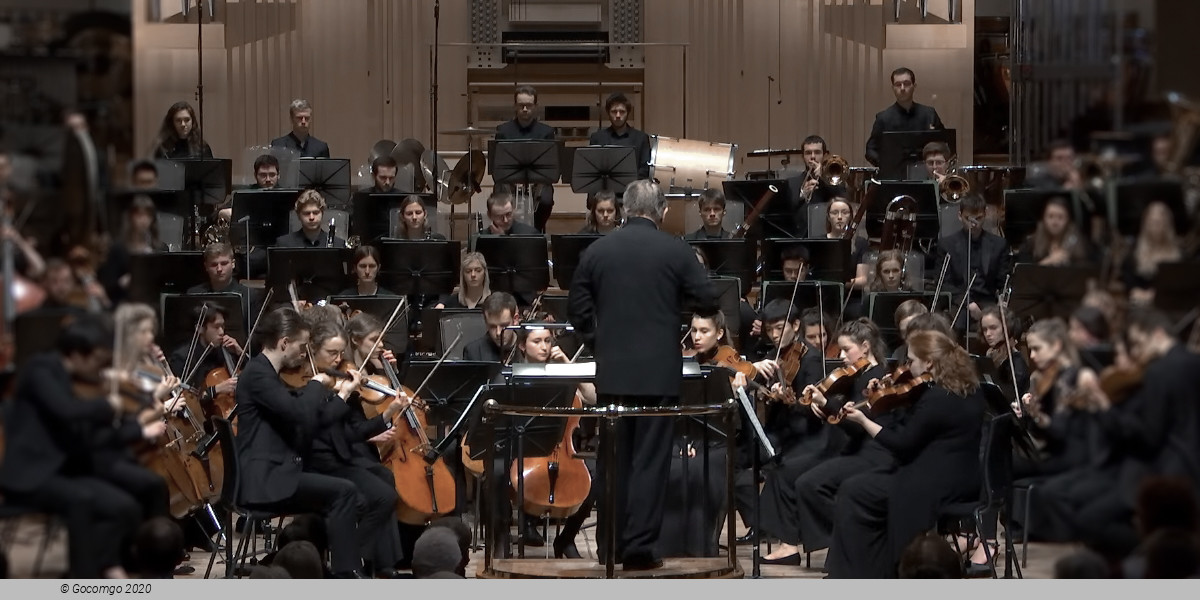
Concertgebouw: Grosse Fuge in B-flat major, Op. 133 Tickets | Event Dates & Schedule | GoComGo.com

Grosse Fuge in B-flat major, Op. 133 Tickets

Concertgebouw, Amsterdam, Netherlands
All photos (1)
1 / 1
Available Dates: 22 May, 2027 (1 events)
Important Info
Type: Classical Concert
City: Amsterdam, Netherlands

E-tickets: Print at home or at the box office of the event if so specified. You will find more information in your booking confirmation email.

You can only select the category, and not the exact seats.
If you order 2 or 3 tickets: your seats will be next to each other.
If you order 4 or more tickets: your seats will be next to each other, or, if this is not possible, we will provide a combination of groups of seats (at least in pairs, for example 2+2 or 2+3).

Cast
Performers
Choose the date to see the peformers
Creators
Composer: Ludwig van Beethoven
Composer: Maurice Ravel
Composer: Wolfgang Amadeus Mozart
Overview

The Große Fuge (or Grosse Fuge, also known in English as Great Fugue or Grand Fugue), Op. 133, is a single-movement composition for string quartet by Ludwig van Beethoven. An immense double fugue, it was universally condemned by contemporary critics. A reviewer writing for Allgemeine musikalische Zeitung in 1826 described the fugue as "incomprehensible, like Chinese" and "a confusion of Babel". However, critical opinion of the work has risen steadily since the beginning of the 20th century. The work is now considered among Beethoven's greatest achievements. Igor Stravinsky said that "[it is] an absolutely contemporary piece of music that will be contemporary forever."

The Große Fuge originally served as the final movement of his Quartet No. 13 in B♭ major (Op. 130), written in 1825. But Beethoven's publisher, who was concerned about the dismal commercial prospects of the piece, urged Beethoven to replace the fugue with a new finale. Beethoven complied, and the Große Fuge was published separately in 1827 as Op. 133. It was composed when Beethoven was almost completely deaf, and is considered to be part of his set of late quartets. It was first performed in 1826, as the finale of the B♭ quartet, by the Schuppanzigh Quartet.

Analysts describe the Große Fuge as "inaccessible", "eccentric", "filled with paradoxes", and "Armaggedon". "[It] stands out as the most problematic single work in Beethoven's output and … doubtless in the entire literature of music", writes critic and musicologist Joseph Kerman of the fugue. Moreover, according to violinist and composer David Matthews, "it is fiendishly difficult to play."

History of composition
Beethoven originally composed the Große Fuge as the final movement of his String Quartet No. 13 (Op. 130). His choice of a fugal form for the last movement was well grounded in tradition: Haydn, Mozart, and Beethoven himself had used fugues as final movements of quartets. But in recent years, Beethoven had become increasingly concerned with the challenge of integrating this Baroque form into the Classical structure. "In my student days I made dozens of [fugues]... but [imagination] also wishes to exert its privileges... and a new and really poetic element must be introduced into the traditional form," Beethoven wrote. The resulting movement was a mammoth work, longer than all the other movements of the quartet together. Beethoven wrote at the top of the score, "Grande fugue tantôt libre, tantôt recherchée" (a grand fugue, somewhat free, somewhat researched), an indication of his ambition to reconcile the academic and the romantic. The fugue is dedicated to the Archduke Rudolf of Austria, his student and patron.

At the first performance of the quartet, other movements were received enthusiastically, but the fugue was not a success. A review of the performance in the Allgemeine musikalische Zeitung, one of Vienna's leading music periodicals, called the fugue "incomprehensible, like Chinese" and "a confusion of Babel". Composer and violinist Louis Spohr called the fugue, and the other late quartets, "an indecipherable, uncorrected horror."

Despite the contemporary criticism, Beethoven himself never doubted the value of the fugue. Karl Holz, Beethoven's confidant and second violinist of the Schuppanzigh quartet that performed the work, brought Beethoven the news that the audience had demanded encores of two middle movements. Beethoven, enraged, was reported to have growled, "And why didn't they encore the Fugue? That alone should have been repeated! Cattle! Asses!"

However, the fugue was so roundly condemned by critics and audience alike that Beethoven's publisher, Matthias Artaria (1793–1835), decided to try to convince Beethoven to publish it separately. Holz was given the task of convincing Beethoven to separate the fugue from the rest of the quartet. Holz wrote:

Artaria...charged me with the terrible and difficult task of convincing Beethoven to compose a new finale, which would be more accessible to the listeners as well as the instrumentalists, to substitute for the fugue which was so difficult to understand. I maintained to Beethoven that this fugue, which departed from the ordinary and surpassed even the last quartets in originality, should be published as a separate work and that it merited a designation as a separate opus. I communicated to him that Artaria was disposed to pay him a supplementary honorarium for the new finale. Beethoven told me he would reflect on it, but already on the next day I received a letter giving his agreement.

Why the notoriously stubborn Beethoven agreed so readily to replace the fugue is an enigma in the history of this quintessentially enigmatic piece. Historians have speculated that he did it for the money (given that Beethoven was extremely bad at managing his personal finances), or to satisfy his critics, or because he simply came to believe the fugue stood best on its own. The fugue is connected to the other movements of opus 130 by various hints of motifs, and by a tonal link to the preceding Cavatina movement (the Cavatina ends on a G, and the fugue begins with the same G). The replacement final movement, on the other hand (which also begins on a G), is relatively light in character and completely uncontroversial. (Beethoven composed it, the last substantial piece of music he was to write, in late 1826.) In May 1827, about two months after Beethoven's death, Matthias Artaria published the first edition of Op. 130 with the new finale, and the Große Fuge as Op. 133, as well as a four-hand piano arrangement, Op. 134.

Venue Info

Concertgebouw - Amsterdam
Location   Concertgebouwplein 10

The Royal Concertgebouw is a concert hall in Amsterdam, Netherlands. The Dutch term "concertgebouw" literally translates into English as "concert building". On 11 April 2013, on occasion of the building's 125th anniversary, Queen Beatrix bestowed the Royal Title "Koninklijk" upon the building, as she did previously (in 1988) to the Royal Concertgebouw Orchestra. Because of its highly regarded acoustics, the Concertgebouw is considered one of the finest concert halls in the world, along with places such as Boston's Symphony Hall and the Musikverein in Vienna.

The architect of the building was Adolf Leonard van Gendt, who was inspired by the Gewandhaus in Leipzig, built two years earlier (and destroyed in 1943).

Construction began in 1883 in a pasture that was then outside the city, in Nieuwer-Amstel, a municipality that in 1964 became Amstelveen. A total of 2,186 piles of length twelve to thirteen metres (40 to 43 ft) were sunk into the soil. The Concertgebouw was completed in late 1886, however due to the difficulties with the municipality of Nieuwer-Amstel - filling in a small canal, paving the access roads and installing street lights - the grand opening of the building was delayed.

The hall opened on 11 April 1888 with an inaugural concert, in which an orchestra of 120 musicians and a chorus of 500 singers participated, performing works of Wagner, Handel, Bach, and Beethoven. The resident orchestra of the Concertgebouw is the Royal Concertgebouw Orchestra (Koninklijk Concertgebouworkest), which gave its first concert in the hall on 3 November 1888, as the Concertgebouw Orchestra (Concertgebouworkest). For many decades the Netherlands Philharmonic Orchestra and the Radio Filharmonisch Orkest have also been regular performers in the Concertgebouw.

The Main Hall (Grote Zaal) seats 1,974, and is 44 metres (144 ft) long, 28 metres (92 ft) wide, and 17 metres (56 ft) high. Its reverberation time is 2.8 seconds without audience, 2.2 seconds with, making it ideal for the late Romantic repertoire such as Mahler. Although this characteristic makes it largely unsuited for amplified music, groups such as Led Zeppelin, Pink Floyd and The Who did perform there in the 1960s. It hosts not only orchestral and operatic performances, but also jazz and world music.

A smaller, oval-shaped venue, the Recital Hall (Kleine Zaal), is located behind the Main Hall. The Recital Hall is 20 metres (66 ft) long and 15 metres (50 ft) wide. Its more intimate space is well-suited for chamber music and Lieder. The Recital Hall has 437 seats.

When the Concertgebouw was built, acoustics were something of a black art. As in shipbuilding, designers drew upon what had worked in the past without entirely understanding the underlying science. When the building was completed, the acoustics were not perfect, and a lot of effort went into fine-tuning the aural ambience. During later restorations, particular care has been taken not to alter the materials used for interior decoration with this in mind.

In 1983, the Concertgebouw was found to be sinking into the damp Amsterdam earth, with several inch-wide cracks appearing in the walls, so the hall embarked on extensive fundraising for renovations. Its difficult emergency restoration started in 1985, during which the 2,186 rotting wooden pilings were replaced with concrete pillars. Pi de Bruijn, Dutch architect designed a modern annex for a new entrance and a basement to replace cramped dressing and rehearsal space.

Today, some nine hundred concerts and other events per year take place in the Concertgebouw, for a public of over 700,000, making it one of the most-visited concert halls in the world.

As of February 2014, the managing director of the Concertgebouw is Simon Reinink and the artistic director is Anneke Hogenstijn.

The organ was built in 1890 by the organ builder Michael Maarschalkerweerd from Utrecht, and was renovated in the years 1990 to 1993 by the organ builder Flentrop. It has 60 registers on three divisions and pedal.

Important Info
Type: Classical Concert
City: Amsterdam, Netherlands

E-tickets: Print at home or at the box office of the event if so specified. You will find more information in your booking confirmation email.

You can only select the category, and not the exact seats.
If you order 2 or 3 tickets: your seats will be next to each other.
If you order 4 or more tickets: your seats will be next to each other, or, if this is not possible, we will provide a combination of groups of seats (at least in pairs, for example 2+2 or 2+3).

From
$ 94
Top of page