Glyndebourne: La cenerentola Tickets | Event Dates & Schedule | GoComGo.com

La cenerentola Tickets

Glyndebourne, Lewes, Great Britain
All photos (6)
1 / 6
Available Dates: 13 Jun - 20 Aug, 2027 (17 events)
Important Info
Type: Opera
City: Lewes, Great Britain

E-tickets: Print at home or at the box office of the event if so specified. You will find more information in your booking confirmation email.

You can only select the category, and not the exact seats.
If you order 2 or 3 tickets: your seats will be next to each other.
If you order 4 or more tickets: your seats will be next to each other, or, if this is not possible, we will provide a combination of groups of seats (at least in pairs, for example 2+2 or 2+3).

Cast
Performers
Choose the date to see the peformers
Creators
Composer: Gioachino Rossini
Author: Charles Perrault
Librettist: Jacopo Ferretti
Director: Max Webster
Overview

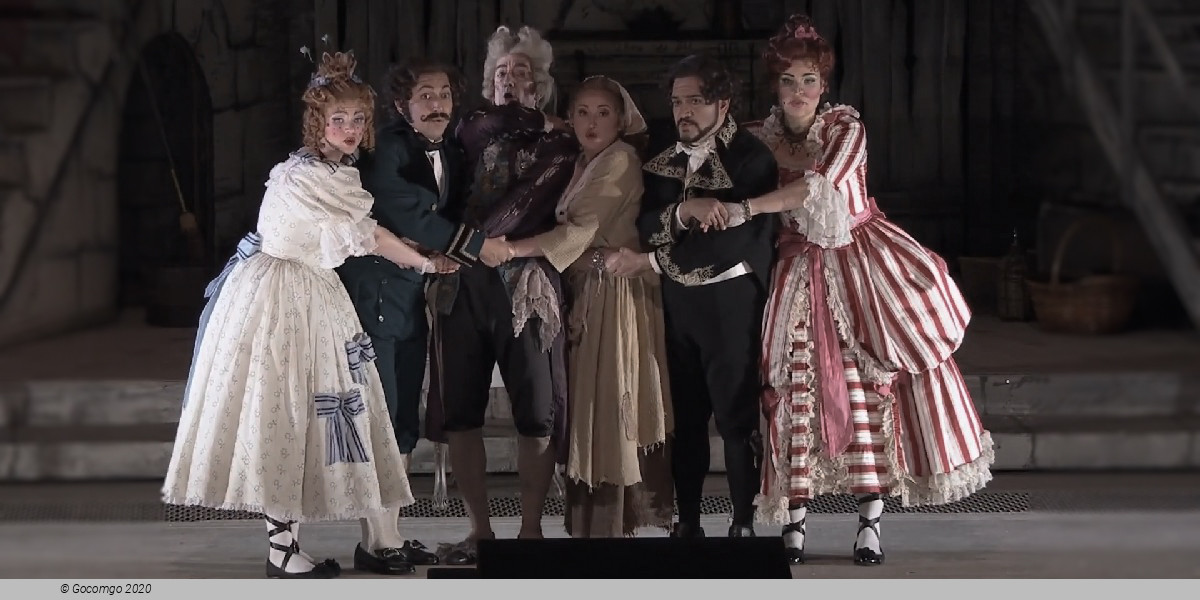
Gioachino Rossini’s La Cenerentola returns to Glyndebourne in summer 2027 in a brand-new production—the first new staging of the opera at the Festival in more than 20 years.

New Production

This sparkling comedy receives a fresh theatrical interpretation from Olivier and Tony-nominated director Max Webster, making his Glyndebourne debut. His production promises to bring Rossini’s wit, energy and warmth to the stage with a distinctly contemporary sense of play.

At the heart of the story is Angelina, better known as Cenerentola, whose intelligence and generosity ultimately triumph over vanity and social ambition. Rather than relying on magical transformation, Rossini’s version of the Cinderella tale turns on human character, mistaken identities and the unexpected discovery of love. Its infectious ensembles, rapid-fire comedy and dazzling vocal writing make La Cenerentola one of opera’s most irresistible comic masterpieces.

History
Premiere of this production: 25 January 1817, Teatro Valle, Rome

La Cenerentola, ossia La bontà in trionfo (Cinderella, or Goodness Triumphant) is an operatic dramma giocoso in two acts by Gioachino Rossini. The libretto was written by Jacopo Ferretti, based on the fairy tale Cendrillon by Charles Perrault. The opera was first performed in Rome's Teatro Valle on 25 January 1817.

Synopsis

In this variation of the fairy tale, the wicked stepmother is replaced by a stepfather, Don Magnifico. The Fairy Godmother is replaced by Alidoro, a philosopher and tutor to the Prince. Cinderella is identified not by a glass slipper but by her bracelet. The supernatural elements that traditionally characterize the Cinderella story were removed from the libretto, simply for ease of staging.

Time: Late 18th century – early 19th century
Place: Salerno (Italy)

Act 1

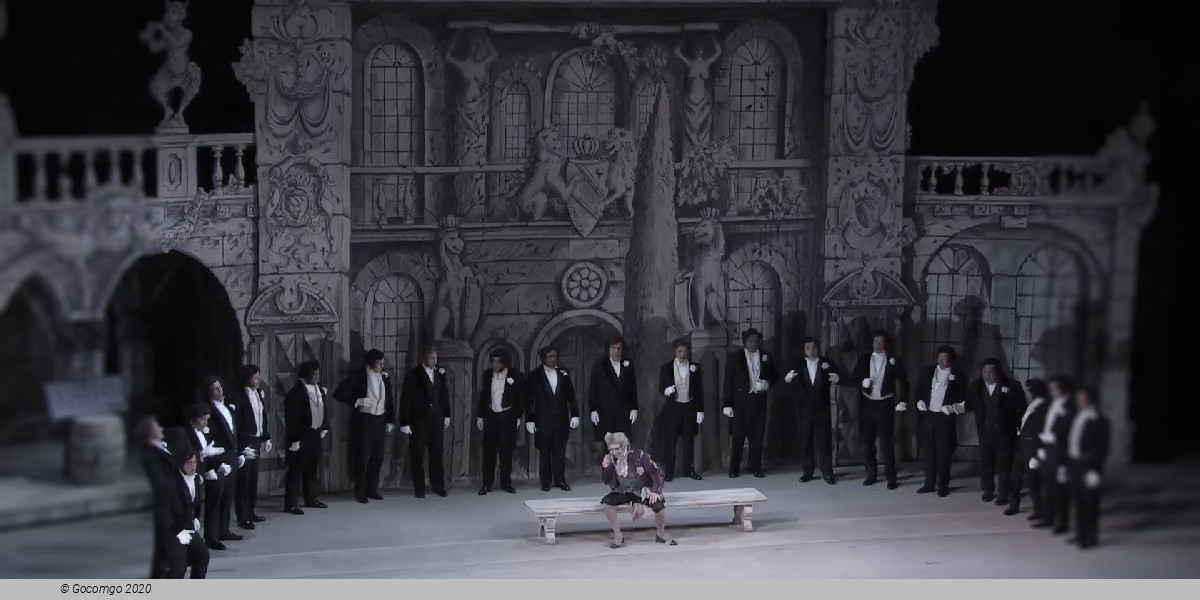
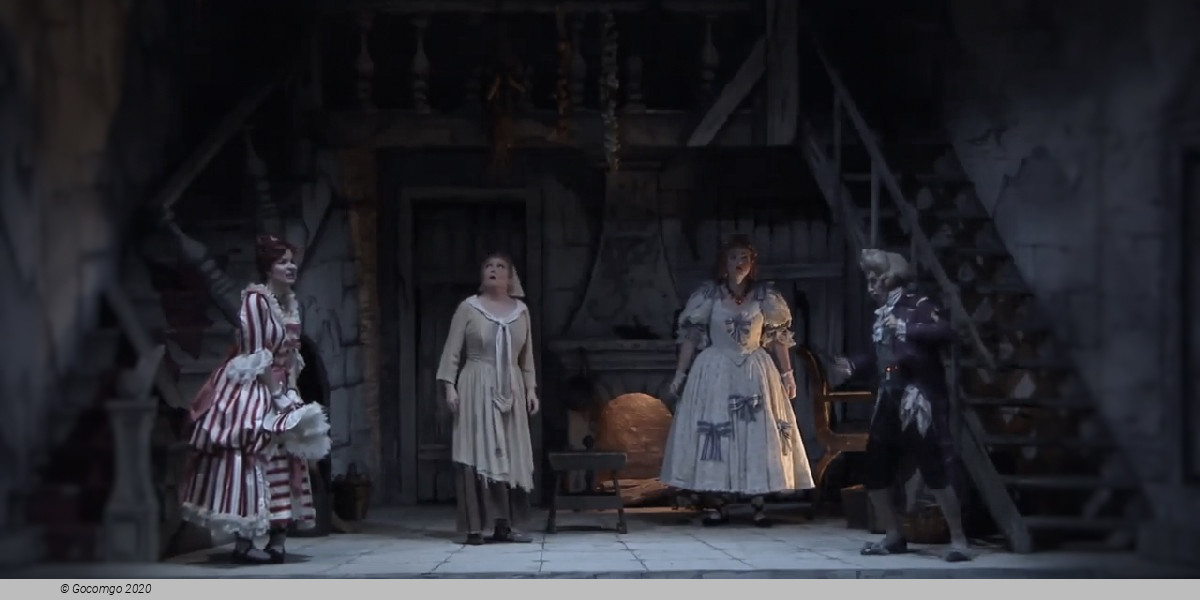
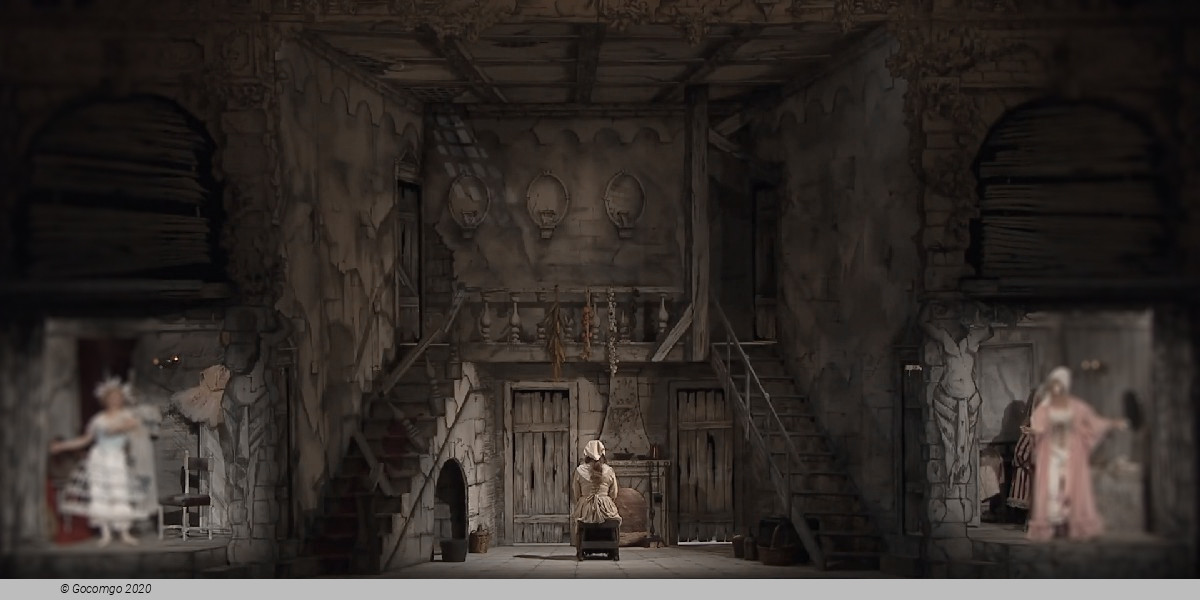
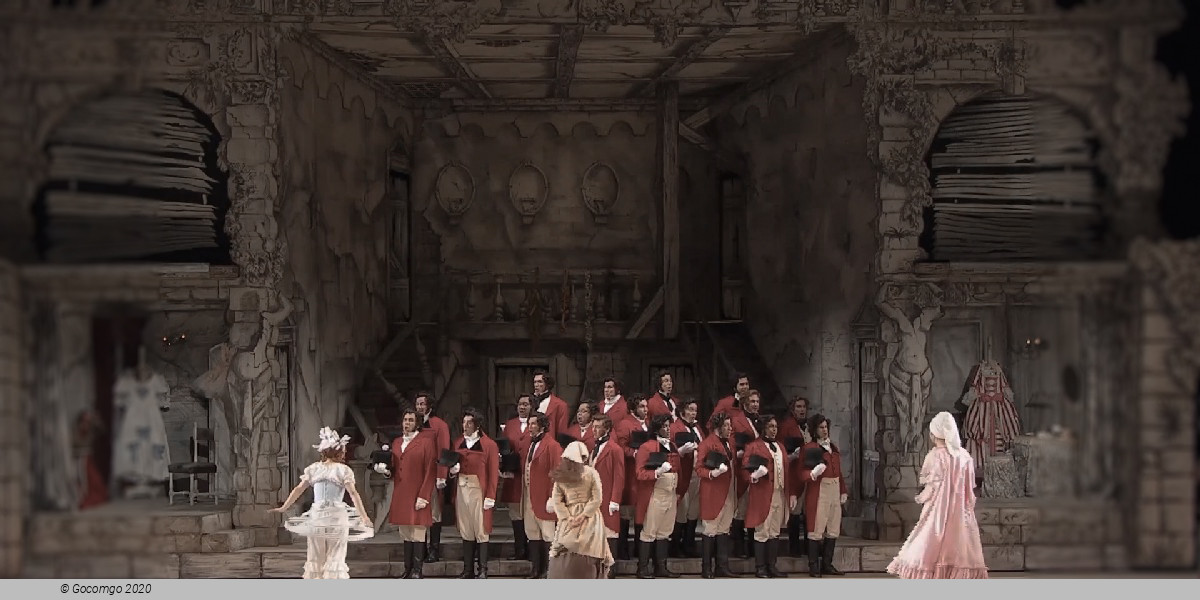
Angelina, known to her stepfather and stepsisters as "Cenerentola", is forced to serve as the maid in her own home. She sings of a king who married a common girl ("Una volta c’era un rè"). A beggar arrives; her stepsisters, Clorinda and Tisbe, want to send him away, but Cenerentola gives him bread and coffee. Courtiers follow, announcing that Prince Ramiro will come to visit while he searches for the most beautiful girl in the land to wed. Cenerentola's stepfather, Don Magnifico, hopes to use this as an opportunity to save his own failing fortune.

When the room is empty, Ramiro enters alone, disguised as a valet. The "beggar" - in fact, his tutor, Alidoro - has informed him of a goodhearted young woman spotted here. Ramiro intends to find her incognito. Cenerentola returns, and she and Ramiro are attracted to each other (duet: "Un soave non-so che"), but when he asks who she is, she's overwhelmed and flees.

Finally, the "prince" arrives – the real valet, Dandini, who has taken his master's place - and Magnifico, Clorinda, and Tisbe fall over themselves to flatter him. He invites the family to a ball that evening, where he plans to find his bride; Cenerentola asks to join them, but Magnifico refuses (quintet: "Signor, una parola"). This callousness isn't lost on Ramiro. Alidoro, still in his rags, returns to inquire after a third daughter in the house; Magnifico claims she has died. Left alone with Cenerentola, Alidoro promises to take her to the ball himself, and that God will reward her kindness ("Là del ciel nell’arcano profondo").

The prince and his valet have retired to Ramiro's country house in some confusion, as neither of Magnifico's daughters resembled the worthy bride Alidoro had described. When Clorinda and Tisbe arrive, Dandini gives them a little test: he offers his "valet" to whichever sister the "prince" does not marry. The ladies are outraged at the idea of marrying a servant. Alidoro then arrives with a beautiful, unknown lady who strangely resembles Cenerentola. Unable to make sense of the situation, they all sit down to supper, feeling as if they are in a dream.

Act 2

Magnifico frets over the competition his daughters now face from the strange lady ("Sia qualunque delle figlie"), but Cenerentola isn't interested in the "prince," saying she's fallen in love with his servant. An overjoyed Ramiro steps forward; however, Cenerentola tells him that she's going home and doesn't want him to follow her. If he really cares for her, she says, he will find her, giving him one of a matching pair of bracelets. The prince determines to do exactly that ("Sì, ritrovarla io giuro").

Meanwhile, Magnifico confronts the disguised Dandini, insisting that he choose one of his daughters to marry. Dandini tries to stall, but is forced to admit that he's actually the valet and not the prince at all (duet: "Un segreto d’importanza").

A furious Magnifico and his daughters return home, where they order Cenerentola, back in rags, to serve them. A storm is thundering outside. Alidoro sabotages Ramiro's carriage so that it breaks down in front of Magnifico's manor, forcing the prince to take refuge within. Cenerentola and Ramiro recognize each other's bracelets; the others comment on the situation (sextet: "Siete voi?"). When Ramiro threatens Cenerentola's recalcitrant family, she asks him to forgive them.

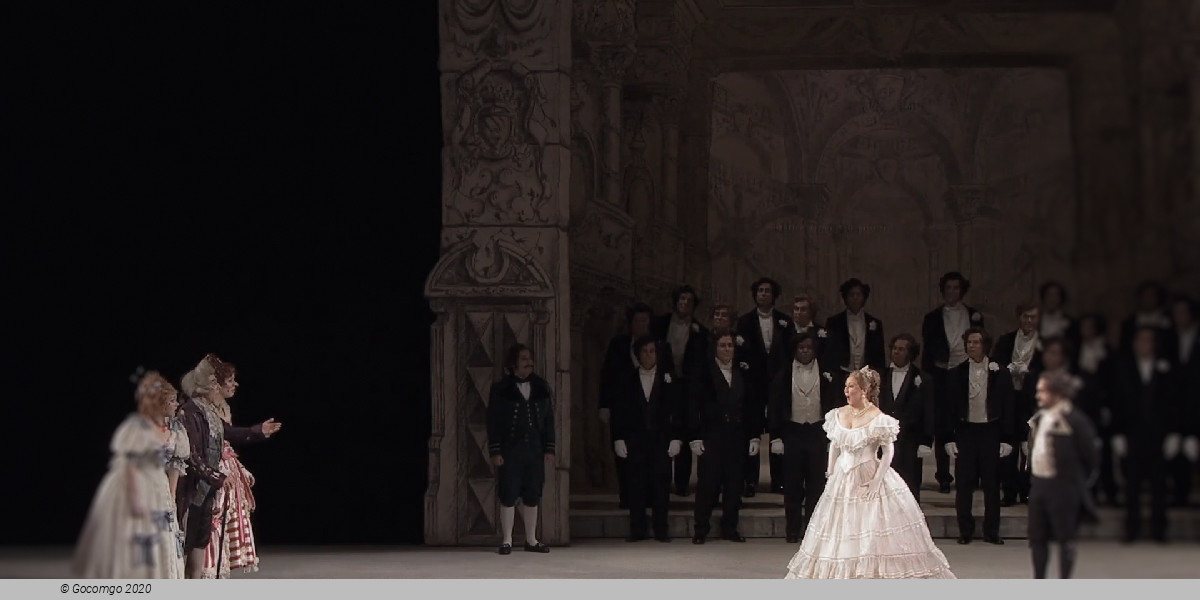
Ramiro and Cenerentola are married, and celebrate their wedding at the palace. Magnifico tries to win the favor of the new princess, but she asks only to be acknowledged, at last, as his daughter. She reflects on the misfortune to which she was born and the sudden reversal of her fate, then forgives her family for all her past unhappiness, adding that her days of sitting sadly by the fire are over ("Nacqui all'affanno... Non più mesta"). Everyone present acknowledges that she truly is worthy of the throne.

Venue Info

Glyndebourne - Lewes
Location   New Road, BN8 5UU

Glyndebourne is an English country house, the site of an opera house that, since 1934, has been the venue for the annual Glyndebourne Festival Opera. Initially, operas were presented within the house but there is now a free-standing opera house in its grounds. The house itself, located near Lewes in East Sussex, England, is thought to be about six hundred years old and listed at grade II.

Origins of the opera house

John Christie obtained the use of the house in 1913 after the death of William Langham Christie, his grandfather. He came into full legal possession of the estate in 1920. Among other renovations, he added to the house an organ room, 80 feet (24 m) long, in the process almost doubling the length of the south facade of the house. This room contained one of the largest organs outside of a cathedral in the country. It was built by the firm of Hill, Norman & Beard Ltd (bought by Christie in 1923). After the Second World War, John Christie made a gift of sections of the soundboards, pipes and structural parts to the rebuilt Guards Chapel, Wellington Barracks (which had been destroyed in the Blitz); the case and console remain at Glyndebourne.

John Christie's fondness for music led him to hold regular amateur opera evenings in this room. At one of these evenings in 1931, he met his future wife, the Sussex-born Canadian soprano Audrey Mildmay, a singer with the Carl Rosa Opera company who had been engaged to add a touch of professionalism to the proceedings. They were married on 4 June 1931. During their honeymoon, they attended the Salzburg and Bayreuth festivals, which gave them the idea of bringing professional opera to Glyndebourne, although Christie's original concept was for it to be similar to the Bayreuth Festival. As their ideas evolved, the concept changed to focus on smaller-scale productions of operas by Mozart more suited to the intimate scale of the planned theatre.

The first theatre

As an annex to the organ room, the Christies built a fully equipped and up-to-date theatre with a 300-seat auditorium and an orchestra pit capable of holding a symphony orchestra. Christie engaged conductor Fritz Busch as the first music director, Carl Ebert, the Intendant of Berlin's Städtische Oper as artistic director, and Rudolf Bing became general manager until 1949. All three men were exiles from Nazi Germany.

After extensive rehearsals, the first six-week season opened on 28 May 1934 with a performance of Le nozze di Figaro followed by Così fan tutte. Boyd Neel had conducted the first music heard in the renovated Glyndebourne opera house in 1934, in private performances, at John Christie.
John Christie's original theatre was soon enlarged and improved many times after its initial construction. As early as 1936 its capacity was increased to 433; by 1952 it held nearly 600, and finally, in 1977, it held 850 people. In addition, a rehearsal hall was constructed.

Productions were interrupted by the Second World War, during which time the house became an evacuation centre for children from London. After 1945 the Festival slowly began again. Until 1951, the entire burden of financing the opera festival was undertaken by John Christie himself, but, in 1952, the Glyndebourne Festival Society was formed to take over the financial management. Christie's death in 1962 resulted in his son George (later Sir George) taking over, and additional changes and improvements to the theatre continued.

Hill, Norman and Beard built the pipe organ in 1924, and it gradually expanded over the years. John Christie owned a considerable share in the company. Currently, the organ is a gutted shell, the pipes having been donated to various churches for the construction of new organs after World War II. The organ originally contained 4 manuals and 46 stops, but this was eventually expanded to 106 stops, unusual for an English-built organ in having multiple diapason chorus ranks of pipes.

A short semi-documentary film was made in 1955 entitled On Such a Night, featuring excerpts from that year's production of Le nozze di Figaro and with glimpses of John Christie, Vittorio Gui and Carl Ebert, interwoven with fictional story about an American going there for the first time.

The present theatre

By the late 1980s the theatre's expansion, which had proceeded in a somewhat piecemeal fashion, included an agglomeration of outbuildings which housed restaurants, dressing rooms, storage and other facilities. It became clear to George Christie that a completely new theatre - and not just an enlargement of the old one - was necessary. Having chosen the architects Michael and Patty Hopkins of Hopkins Architects in a design competition, Christie announced in 1990 that a new theatre, capable of seating 1,200 people, would be constructed in 1992.

The old theatre hosted its last festival in 1992, and construction of a brand-new theatre was under way. It was completed at a cost of £34 million, 90 per cent of which was raised through donations, which gave the donors control of 28% of the seats. The inaugural performance in the new theatre on 28 May 1994, given sixty years to the day after the old theatre's first performance, was Le nozze di Figaro.

The design of the theatre, a large brick oval building, has resulted in a four-level, horseshoe-shaped auditorium with main level seating, two balconies, and a gallery topped with a circular roof. The over sixty-foot-high stage building is semi-circular in shape and allows for the efficient flying and storage of scenery. The acoustics, by Derek Sugden and Rob Harris of Arup Acoustics, have received praise.

Important Info
Type: Opera
City: Lewes, Great Britain

E-tickets: Print at home or at the box office of the event if so specified. You will find more information in your booking confirmation email.

You can only select the category, and not the exact seats.
If you order 2 or 3 tickets: your seats will be next to each other.
If you order 4 or more tickets: your seats will be next to each other, or, if this is not possible, we will provide a combination of groups of seats (at least in pairs, for example 2+2 or 2+3).

From
$ 157
Top of page