Kabukiza Theatre 11 June 2022 - June at the Kabukiza Theatre | GoComGo.com

June at the Kabukiza Theatre

Kabukiza Theatre, Tokyo, Japan
All photos (3)
Select date and time
11 AM

E-tickets: Print at home or at the box office of the event if so specified. You will find more information in your booking confirmation email.

You can only select the category, and not the exact seats.
If you order 2 or 3 tickets: your seats will be next to each other.
If you order 4 or more tickets: your seats will be next to each other, or, if this is not possible, we will provide a combination of groups of seats (at least in pairs, for example 2+2 or 2+3).

Important Info
Type: Show
City: Tokyo, Japan
Starts at: 11:00
Acts: 3
Intervals: 2

E-tickets: Print at home or at the box office of the event if so specified. You will find more information in your booking confirmation email.

You can only select the category, and not the exact seats.
If you order 2 or 3 tickets: your seats will be next to each other.
If you order 4 or more tickets: your seats will be next to each other, or, if this is not possible, we will provide a combination of groups of seats (at least in pairs, for example 2+2 or 2+3).

Overview

Part 1: 11:00 AM

Part 2: 2:15 PM

Part 3: 6:00 PM

The June program consists of various genres of works. In Part 1, a visually brilliant play performed in the 'aragoto' rough or wild style of acting can be seen, along with a dance drama from “The Ten Dance Plays of the Omodakaya family” that represent the special art of Ichikawa En'ō I. In Part 2, you can enjoy a New Kabuki play about a father and son's tragedy, whose roles will be performed by a real life actor and his grandson, as well as a dance accompanied by Tokiwazu music that is filled with the atmosphere of old Tokyo. In Part 3, you can see a masterpiece that originated as Shingeki (literally, 'New drama', an early 20th century theatre form based on modern realism) which Bandō Tamasaburō later performed as kabuki and which has become very popular.

Each month's program will consist of three parts. Between each part there will be an intermission.

Part 1:

SUGAWARA DENJU TENARAI KAGAMI ('Pulling the Carriage Apart' from 'Sugawara's Secrets of Calligraphy')
Kurumabiki

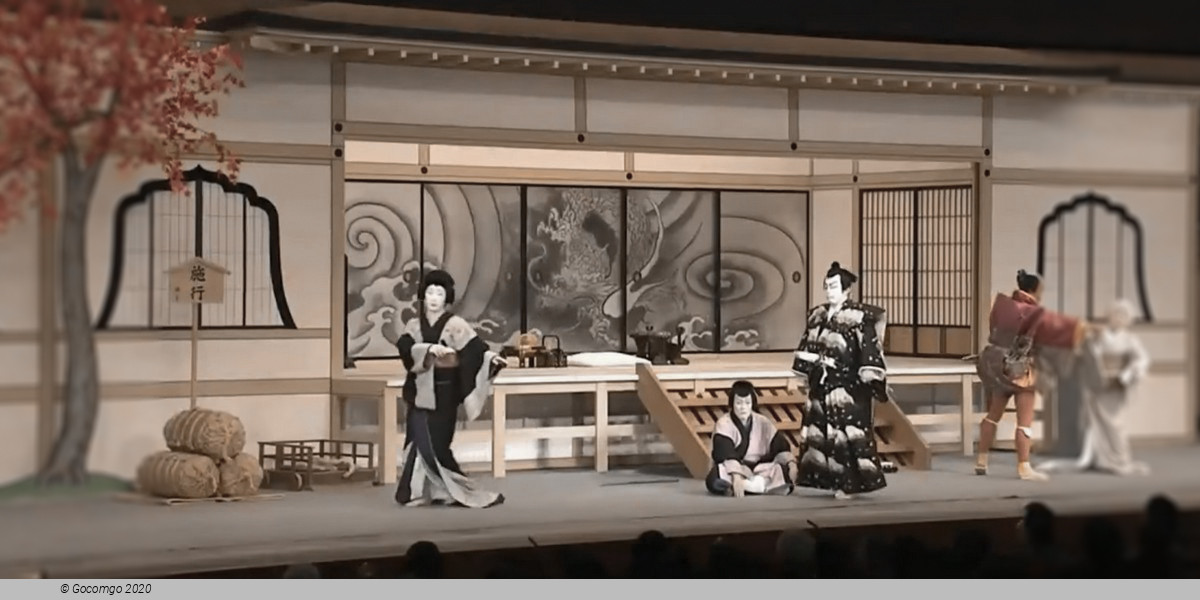
Umeōmaru and his triplet brother, Sakuramaru, try to get revenge on Fujiwara no Shihei who falsely accused Umeōmaru's lord, Kan Shōjō, of treason. However, they are confronted by their other brother, Matsuōmaru, who is one of Shihei's retainers. The energetic performance of Umeōmaru is a showcase for the bombastic 'aragoto' style of acting.

CHO HAKKAI ('Zhu Bajie')

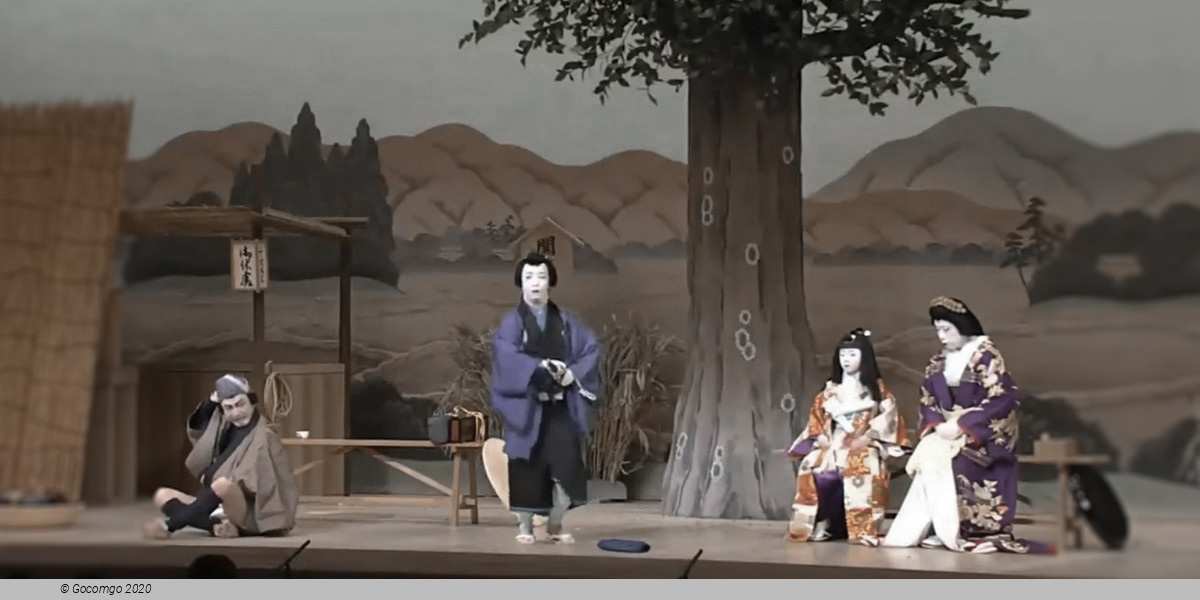
The Great Demon King who is enshrined by the Tongitan River on the way from China to India demands human victims from the village every year. Since he torments the villagers, Priest Xuan Zang and his party plot to exterminate him, disguising Zhu Bajie as a girl and sending him as a substitute for a victim. However, Zhu Bajie gets drunk before the Great Demon King appears with a terrible expression on his face ...

Part 2:

NOBUYASU ('Nobuyasu')

Tokugawa Ieyasu makes a sudden visit to his eldest son Nobuyasu and reprimands him for having been suspected as a rebel. In fact, Oda Nobunaga had commanded Ieyasu to kill Nobuyasu because he had grown concerned about Nobuyasu's excellence, but Ieyasu orders Nobuyasu to bide his time at his castle. Nobuyasu determines to die for his clan despite his father's efforts to spare his life ...
This play focuses on Nobuyasu's psychological conflict with his father who cannot disobey Nobunaga's order as he is about to unify the country.

KIOI JISHI ('The Spirited Lion')

This dance depicts the Sannō Festival in Edo (old Tokyo) with its lively lion dance and other entertainments. The festival is full of handsome firemen and attractive geisha who perform a series of graceful dances. One of the dances' highlights features the story of the Soga brothers avenging their father's death.

Part 3:

FURU AMERIKA NI SODE WA NURASAJI
In preparation


A kabuki program is usually made up of several different plays and dances, but at the Kabukiza Theatre, 'Single Act Seats' are available so that you can watch just one of the acts.

Single Act Tickets will be sold on the day of the performance (they cannot be reserved or purchased in advance).

Tea will not be offered at the Box Seats. Please refrain from eating at seats as well.

Venue Info

Kabukiza Theatre - Tokyo
Location   4 Chome-12-15 Ginza, Chuo City

Kabuki-za in Ginza is the principal theater in Tokyo for the traditional kabuki drama form.

The Kabuki-za was originally opened by a Meiji era journalist, Fukuchi Gen'ichirō. Fukuchi wrote kabuki dramas in which Ichikawa Danjūrō IX and others starred; upon Danjūrō's death in 1903, Fukuchi retired from the management of the theater. 

The original Kabuki-za was a wooden structure, built in 1889 on land which had been either the Tokyo residence of the Hosokawa clan of Kumamoto, or that of Matsudaira clan of Izu.

The building was destroyed on October 30, 1921, by an electrical fire. The reconstruction, which commenced in 1922, was designed to "be fireproof, yet carry traditional Japanese architectural styles", while using Western building materials and lighting equipment. Reconstruction had not been completed when it again burned down during the 1923 Great Kantō earthquake. Rebuilding was finally completed in 1924.

The theater was destroyed once again by Allied bombing during World War II. It was restored in 1950 preserving the style of 1924 reconstruction, and was until recently one of Tokyo's more dramatic and traditional buildings.

The 1950 structure was demolished in the spring of 2010, and rebuilt over the ensuing three years. Reasons cited for the reconstruction include concerns over the building's ability to survive earthquakes, as well as accessibility issues. A series of farewell performances, entitled Kabuki-za Sayonara Kōen 
 were held from January through April 2010, after which kabuki performances took place at the nearby Shinbashi Enbujō and elsewhere until the opening of the new theatre complex, which took place on March 28, 2013.

The style in 1924 was in a baroque Japanese revivalist style, meant to evoke the architectural details of Japanese castles, as well as temples of pre-Edo period. This style was kept after the post-war reconstruction and again after the 2013 reconstruction.

Inside, with the latest reconstruction the theatre was outfitted with four new front curtains called doncho. These are by renowned Japanese artists in the Nihonga style and reflect the different seasons.

Performances are exclusively run by Shochiku, in which the Kabuki-za Theatrical Corporation is the largest shareholder. They are nearly every day, and tickets are sold for individual acts as well as for each play in its entirety. As is the case for most kabuki venues, programs are organized monthly: each month there is a given set of plays and dances that make up the afternoon performance, and a different set comprising the evening show. These are repeated on a nearly daily schedule for three to four weeks, with the new month bringing a new program.

Important Info
Type: Show
City: Tokyo, Japan
Starts at: 11:00
Acts: 3
Intervals: 2
Top of page