Prague National Theatre: Idomeneo Tickets | Event Dates & Schedule | GoComGo.com

Idomeneo Tickets

Prague National Theatre, Prague, Czech Republic
1 / 6
Available Dates: 12 - 28 Nov, 2026 (4 events)
Important Info
Type: Opera
City: Prague, Czech Republic
Duration: 2h 50min with 1 interval
Acts: 3
Intervals: 1
Sung in: Italian
Titles in: Czech,English

E-tickets: Print at home or at the box office of the event if so specified. You will find more information in your booking confirmation email.

You can only select the category, and not the exact seats.
If you order 2 or 3 tickets: your seats will be next to each other.
If you order 4 or more tickets: your seats will be next to each other, or, if this is not possible, we will provide a combination of groups of seats (at least in pairs, for example 2+2 or 2+3).

Cast
Performers
Choose the date to see the peformers
Creators
Composer: Wolfgang Amadeus Mozart
Director: Calixto Bieito
Librettist: Giambattista Varesco
Overview

A masterful musical depiction of the conflict between paternal authority, romantic passions, and fate.

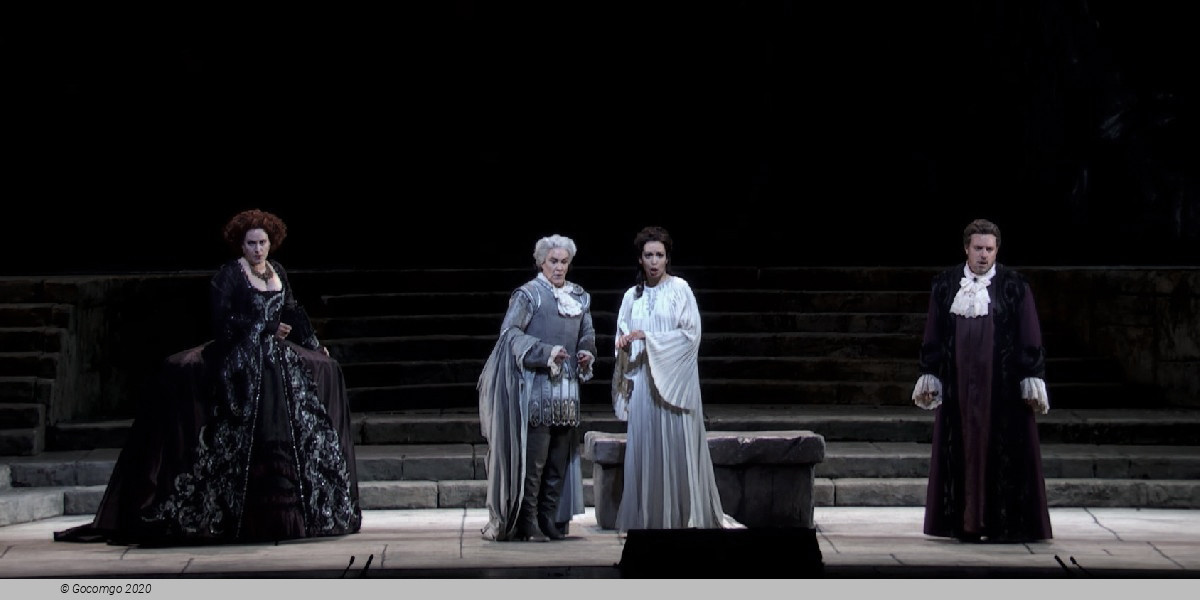
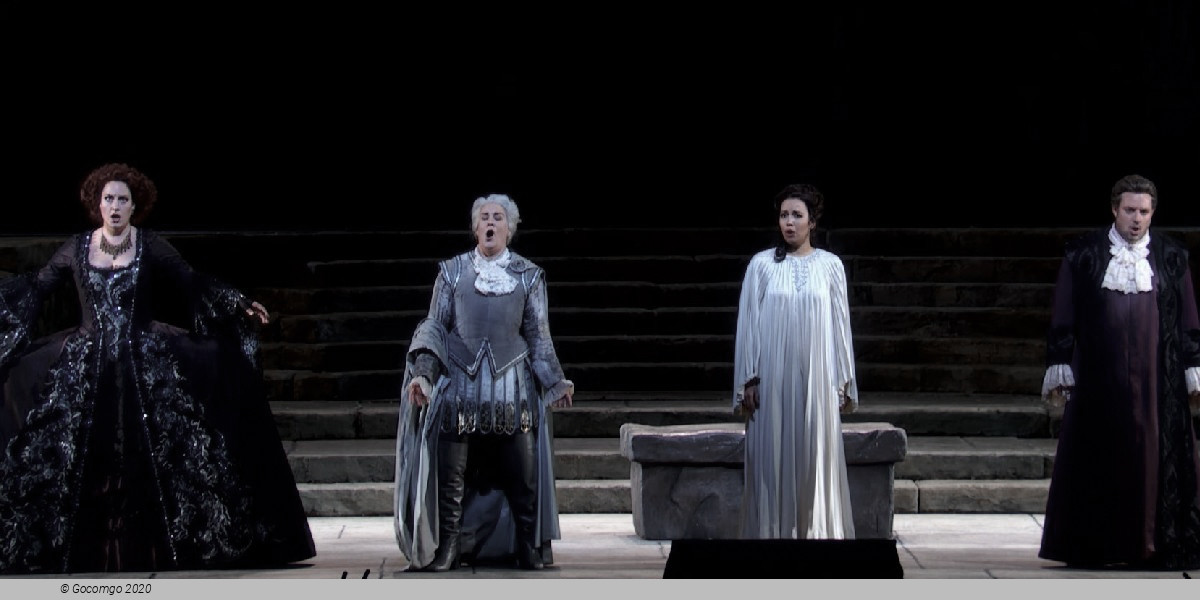
Deemed W. A. Mozart’s first opera masterpiece, Idomeneo presents a ravishing musical rendition of conflict with patriarchal authority, amorous passion and fate.

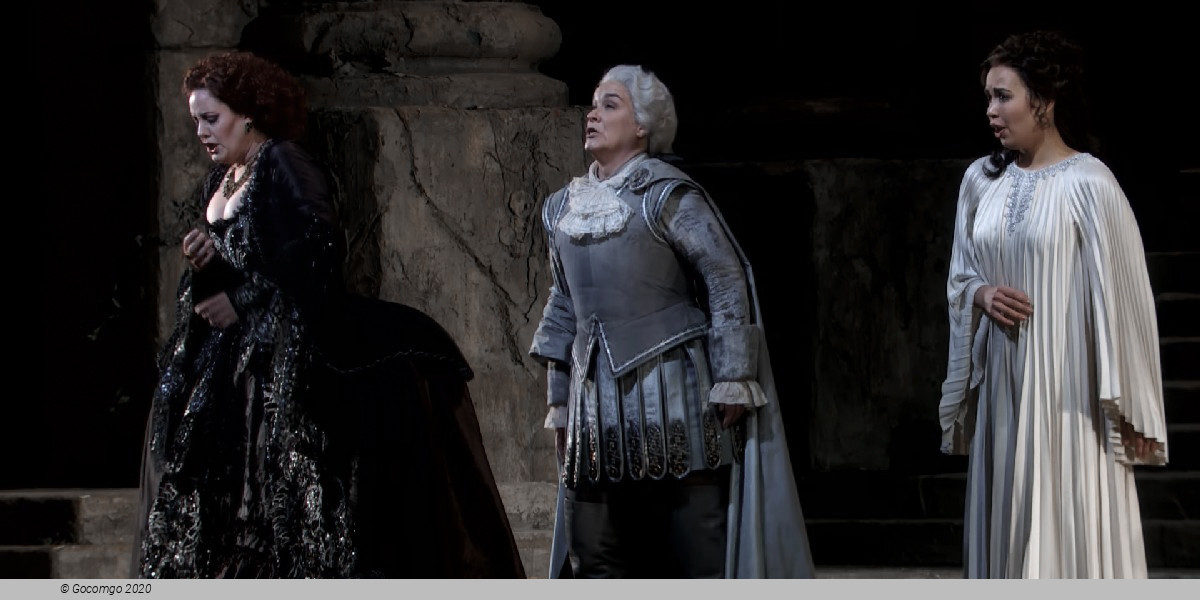
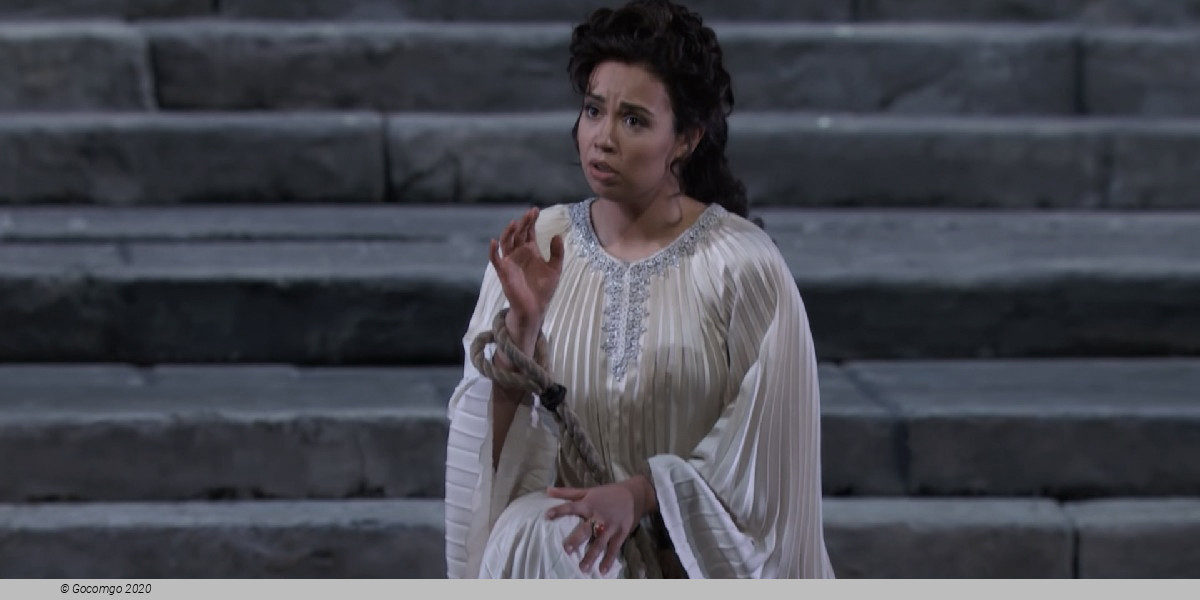
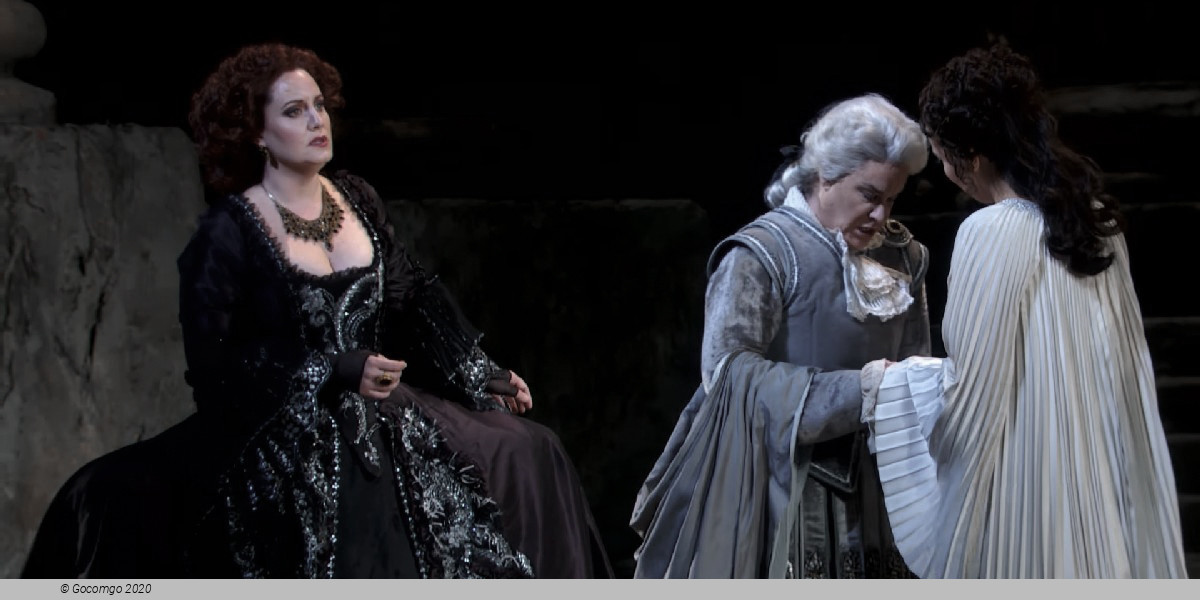
Although W. A. Mozart wrote Idomeneo to commission for the Munich court and Karl Theodor, Elector of Bavaria, a keen patron of the arts, who chose the subject himself, the opera is probably his most personal work (with the patriarchal system of blind obedience and a rebellion of the young seeming to evoke the composer’s tense relationship with his father Leopold), featuring excellently crafted characters. All the main protagonists are confronted with their own weaknesses or inability to defy fate. In the wake of the Trojan War, Idomeneo, King of Crete, made a fateful vow to Neptune, God of the Sea, to be executed should he arrive home safely. Just like the Old Testament’s Jephthah and Abraham, he faces the dilemma of whether to sacrifice his own child or to offend a god. Idomeneo ultimately yields, ready to kill his son, Idamante. Prince Idamante is in love with Ilia, daughter of Priam, the defeated King of Troy, who has lost her family and homeland in the war. Ilia is fond of Idamante, but hesitates to acknowledge her love of an enemy, whose father Idomeneo helped Achilles and Odysseus take Troy. Elettra, daughter of Agamemnon, King of Mycenae, is wildly jealous of Ilia, and intends to win Idamante at any cost. Mozart rendered the heroes’ extreme emotions by means of ravishingly powerful music. He and the librettist Giovanni Battista Varesco ended the Ancient Greek story happily: Idomeneo’s old order gives way to the rule of love and reason, with Idamante and Ilia ascending the throne. 

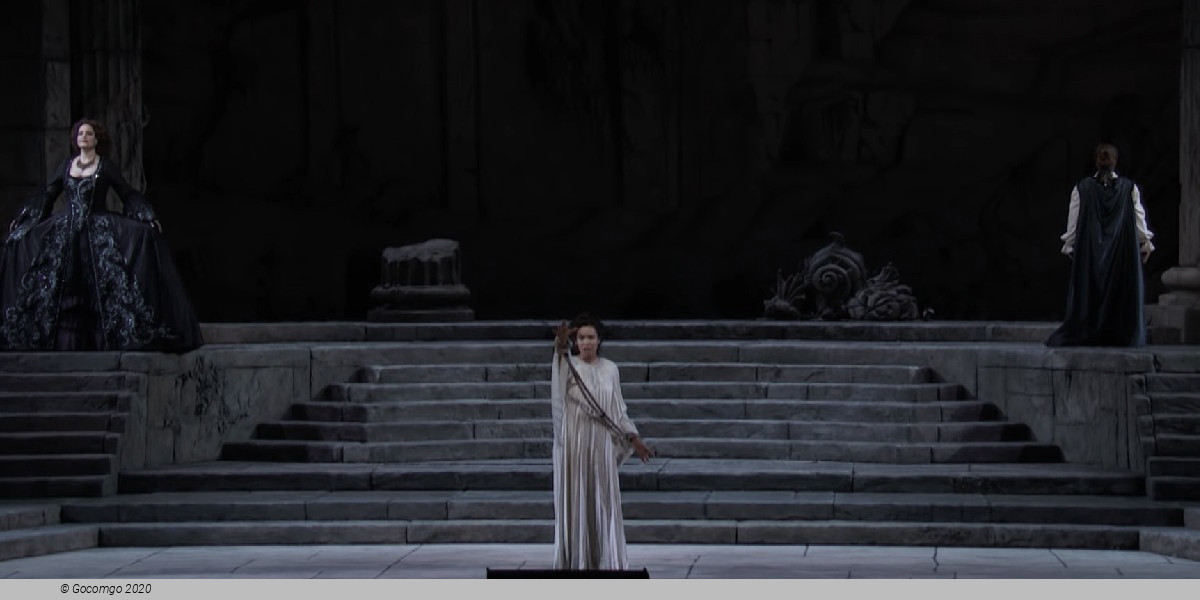
Premiered in Munich on 29 January 1781, Idomeneo is considered Mozart’s first true opera masterpiece. It was first performed in Prague in October 1887, at the Estates Theatre. The current production has been undertaken by the German conductor Konrad Junghänel, who collaborated with the National Theatre Opera for the very first time, and the Spanish director Calixto Bieito, who has previously worked in Prague on several occasions (Flames, Katya Kabanova, Jenůfa).

Coproduction with La Monnaie / De Munt

The production features projections that contain graphic scenes of violence and bloodshed.

The production includes video projections of excerpts from the films Strike and Battleship Potemkin (directed by Sergei M. Eisenstein, 1925), and All Quiet on the Western Front (directed by Lewis Milestone, 1930).

History
Premiere of this production: 29 January 1781, Cuvilliés Theatre, Munich

Idomeneo, re di Creta ossia Ilia e Idamante (Idomeneus, King of Crete) is an Italian language opera seria by Wolfgang Amadeus Mozart. The libretto was adapted by Giambattista Varesco from a French text by Antoine Danchet, which had been set to music by André Campra as Idoménée in 1712. Mozart and Varesco were commissioned in 1780 by Karl Theodor, Elector of Bavaria for a court carnival. He probably chose the subject, though it might have been Mozart. The work premiered on 29 January 1781 at the Cuvilliés Theatre in Munich, Germany.

Synopsis

The overture, in D major and common time, is in a modified sonata form in which the development is but a very short transition section connecting the exposition with the recapitulation. Other conventional hallmarks of the sonata form are apparent: the exposition modulates from the tonic (D major) to the dominant (A major), while the recapitulation is centred on the tonic. The overture concludes with a coda ending in D major chords. These chords, soft and tentative, turn out not to be a resolution of the overture in the tonic but chords in the dominant of G minor, which is the home key of the scene that immediately follows.

Act 1

Island of Crete, shortly after the Trojan War. Ilia, daughter of the defeated Trojan King Priam, has been taken to Crete after the war. She loves Prince Idamante, son of the Cretan King Idomeneo, but hesitates to acknowledge her love. Idamante frees the Trojan prisoners in a gesture of good will. He tells Ilia, who is rejecting his love, that it is not his fault that their fathers were enemies. Trojans and Cretans together welcome the return of peace, but Electra, daughter of the Greek King Agamemnon, is jealous of Ilia and does not approve of Idamante's clemency toward the enemy prisoners. Arbace, the king's confidant, brings news that Idomeneo has been lost at sea while returning to Crete from Troy. Electra, fearing that Ilia, a Trojan, will soon become Queen of Crete, feels the furies of the underworld rise up in her heart (aria: "Tutte nel cor vi sento, furie del crudo averno" – "I feel you all in my heart, furies of the cruel underworld").

Idomeneo is saved by Neptune (god of the sea) and is washed up on a Cretan beach. There he recalls the vow he made to Neptune: to sacrifice, if he should arrive safely on land, the first living creature he should meet. Idamante approaches him, but because the two have not seen each other for a long time, recognition is difficult. When Idomeneo finally realizes the youth that he must sacrifice for the sake of his vow is his own child, he orders Idamante never to seek him out again. Grief-stricken by his father's rejection, Idamante runs off. Cretan troops disembarking from Idomeneo's ship are met by their wives, and all praise Neptune.

Act 2

At the king's palace, Idomeneo seeks counsel from Arbace, who says another victim could be sacrificed if Idamante were sent into exile. Idomeneo orders his son to escort Electra to her home, Argos. Idomeneo's kind words to Ilia move her to declare that since she has lost everything, he will be her father and Crete her country. As she leaves, Idomeneo realizes that sending Idamante into exile has cost Ilia her happiness as well as his own. Electra welcomes the idea of going to Argos with Idamante.

Overture

At the port of Sidon (a fictional city of Crete), Idomeneo bids his son farewell and urges him to learn the art of ruling while he is away. Before the ship can sail, however, a storm breaks out, and a sea serpent appears. Recognizing it as a messenger from Neptune, the king offers himself as atonement for having violated his vow to the god.

Act 3

In the royal garden, Ilia asks the breezes to carry her love to Idamante, who appears, explaining that he must go to fight the serpent. When he says he would rather die than suffer the torments of his rejected love, Ilia confesses her love. They are surprised by Electra and Idomeneo. When Idamante asks his father why he sends him away, Idomeneo can only reply that the youth must leave. Ilia asks for consolation from Electra, who is preoccupied with revenge. Arbace comes with news that the people, led by the High Priest of Neptune, are clamoring for Idomeneo. The High Priest tells the king of the destruction caused by Neptune's monster, urging Idomeneo to reveal the name of the person whose sacrifice is demanded by the god. When the king confesses that his own son is the victim, the populace is horrified.

Outside the temple, the king and High Priest join Neptune's priests in prayer that the god may be appeased. Arbace brings news that Idamante has killed the monster. As Idomeneo fears new reprisals from Neptune, Idamante enters in sacrificial robes, saying he understands his father's torment and is ready to die. After an agonizing farewell, Idomeneo is about to sacrifice his son when Ilia intervenes, offering her own life instead. The Voice of Neptune is heard. Idomeneo must yield the throne to Ilia and Idamante. Everyone is relieved except Electra, who longs for her own death. Idomeneo presents Idamante and his bride as the new rulers. The people call upon the god of love and marriage to bless the royal pair and bring peace.

Venue Info

Prague National Theatre - Prague
Location   Národní 2

The National Theatre is the prime stage of the Czech Republic. It is also one of the symbols of national identity and a part of the European cultural space, with a tradition spanning more than 130 years. It is the bearer of the national cultural heritage, as well as a space for free artistic creation.

The National Theatre (Czech: Národní divadlo) in Prague is known as the alma mater of Czech opera, and as the national monument of Czech history and art.

The National Theatre belongs to the most important Czech cultural institutions, with a rich artistic tradition, which helped to preserve and develop the most important features of the nation–the Czech language and a sense for a Czech musical and dramatic way of thinking.

Today, the National Theatre is made up of four artistic companies – the Opera, Drama, Ballet and Laterna magika. It artistically manages four stages – the three historical buildings: the National Theatre (1883), the State Opera (1888), and the Estates Theatre (1783), and the more recently opened New Stage (1983). The Opera, Drama and Ballet companies perform not only titles from the ample classical legacy, in addition to Czech works, they also focus on contemporary international creation.

Grand opening

The National Theatre was opened for the first time on 11 June 1881, to honour the visit of Crown Prince Rudolf of Austria. Bedřich Smetana's opera Libuše was given its world premiere, conducted by Adolf Čech. Another 11 performances were presented after that. Then the theatre was closed down to enable the completion of the finishing touches. While this work was under way a fire broke out on 12 August 1881, which destroyed the copper dome, the auditorium, and the stage of the theatre.

The fire was seen as a national catastrophe and was met with a mighty wave of determination to take up a new collection: Within 47 days a million guldens were collected. This national enthusiasm, however, did not correspond to the behind-the-scenes battles that flared up following the catastrophe. Architect Josef Zítek was no longer in the running, and his pupil architect Josef Schulz was summoned to work on the reconstruction. He was the one to assert the expansion of the edifice to include the block of flats belonging to Dr. Polák that was situated behind the building of the Provisional Theatre. He made this building a part of the National Theatre and simultaneously changed somewhat the area of the auditorium to improve visibility. He did, however, take into account with utmost sensitivity the style of Zítek's design, and so he managed to merge three buildings by various architects to form an absolute unity of style.

Important Info
Type: Opera
City: Prague, Czech Republic
Duration: 2h 50min with 1 interval
Acts: 3
Intervals: 1
Sung in: Italian
Titles in: Czech,English

E-tickets: Print at home or at the box office of the event if so specified. You will find more information in your booking confirmation email.

You can only select the category, and not the exact seats.
If you order 2 or 3 tickets: your seats will be next to each other.
If you order 4 or more tickets: your seats will be next to each other, or, if this is not possible, we will provide a combination of groups of seats (at least in pairs, for example 2+2 or 2+3).

From
$ 73
Top of page