


Semperoper Dresden tickets 25 March 2027 - The Greek Passion | GoComGo.com

The Greek Passion

Semperoper Dresden, Semperoper Dresden, Dresden, Germany
All photos (3)
Select date and time
7 PM
From
US$ 98

E-tickets: Print at home or at the box office of the event if so specified. You will find more information in your booking confirmation email.

You can only select the category, and not the exact seats.
If you order 2 or 3 tickets: your seats will be next to each other.
If you order 4 or more tickets: your seats will be next to each other, or, if this is not possible, we will provide a combination of groups of seats (at least in pairs, for example 2+2 or 2+3).

Important Info
Type: Opera
City: Dresden, Germany
Starts at: 19:00
Acts: 4
Sung in: English
Titles in: English,German

E-tickets: Print at home or at the box office of the event if so specified. You will find more information in your booking confirmation email.

You can only select the category, and not the exact seats.
If you order 2 or 3 tickets: your seats will be next to each other.
If you order 4 or more tickets: your seats will be next to each other, or, if this is not possible, we will provide a combination of groups of seats (at least in pairs, for example 2+2 or 2+3).

Cast
Performers
Conductor: Erik Nielsen
Tenor: Mario Lerchenberger (Yannakos)
Soprano: Marjukka Tepponen (Katerina)
Bass-Baritone: Markus Marquardt
Bass: Martin-Jan Nijhof
Mezzo-Soprano: N.N. (Michelis)
Creators
Composer: Bohuslav Martinů
Stage Director: Elisabeth Stöppler
Overview

The Greek Passion is a powerful opera by the composer Bohuslav Martinů, performed at the historic Semperoper Dresden. The work tells a dramatic story about faith, compassion, and moral responsibility within a small Greek village. Combining intense drama with expressive orchestral writing and a prominent chorus, the opera explores timeless questions about humanity, justice, and spiritual conviction.

The Greek Passion is one of the most profound and emotionally powerful operas by the Czech composer Bohuslav Martinů. Completed in the mid-twentieth century, the opera is based on the novel Christ Recrucified by Nikos Kazantzakis, the famous author of Zorba the Greek. The work combines philosophical depth with dramatic intensity and remains one of the most compelling operas of the modern repertoire.

The story takes place in a small Greek village where the inhabitants prepare to stage their traditional Passion Play — a theatrical representation of the story of Christ. The villagers assign roles to the participants: some will portray Christ, the apostles, and other biblical figures. However, the boundaries between performance and reality soon begin to blur.

When a group of desperate refugees arrives seeking shelter, the villagers are confronted with a moral dilemma. While some respond with compassion and generosity, others react with fear and hostility. The man chosen to play Christ, Manolios, gradually becomes deeply influenced by the spiritual ideals of his role, leading him to defend the oppressed and challenge the hypocrisy of the community.

Martinů’s music powerfully reflects the emotional and spiritual conflict of the story. The score combines lyrical melodies, dramatic orchestral textures, and powerful choral writing that gives the opera a monumental and almost ritualistic atmosphere. The chorus plays a particularly important role, representing the collective voice of the village and its shifting moral attitudes.

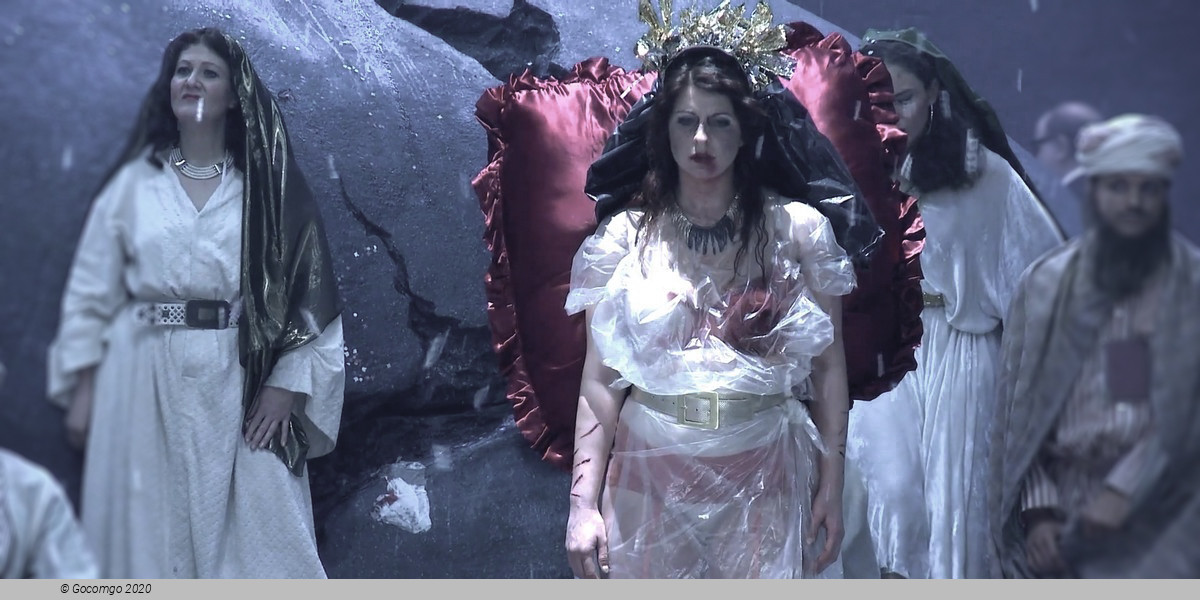
At the Semperoper Dresden, The Greek Passion is presented in a visually striking production that highlights the opera’s timeless themes of faith, humanity, and social responsibility. Through its compelling drama and deeply expressive music, the opera invites audiences to reflect on compassion, moral courage, and the challenges of living according to one’s ideals.

History
Premiere of this production: 19 June 1961, Opernhaus Zürich, Zürich

The Greek Passion is an opera in four acts by Bohuslav Martinů. The English-language libretto, by the composer, is based on Jonathan Griffin's translation of the novel The Greek Passion (or Christ Recrucified) by Nikos Kazantzakis.

Synopsis

The setting is Lykovrissi, a Greek village, where a performance of the Passion Play is scheduled to occur at Easter. As the story proceeds, the villagers cast in the play take on the personalities of their religious characters.

Act 1
The priest Grigoris distributes the roles for the following year's performance of the Passion Play. Café owner Kostandis is allotted James, the pedlar Yannakos Peter, Michelis is given John, shepherd Manolios is selected as Christ; and Katerina, a widow, is chosen to play Mary Magdalene. Panait, her lover, is given the role of Judas much against his wish. The actors are blessed and exhorted to live the life of their roles in the coming year. Manolios is engaged to Lenio who asks him when they are to be married, but he cannot think about marriage any longer. The villagers think of their respective roles and about how they correspond to their lives.

At dawn, singing is heard and a group of Greek refugees arrives in Lykovrissi from a village destroyed by the Turks, led by their priest, Fotis. Father Grigoris is concerned about the welfare and safety of his fellow villagers and of possible conflicts. One female refugee dies from hunger, but Father Grigoris blames the death on cholera and uses this to expel the refugees from the village. Only Katerina offers them practical assistance, but Manolios, Yannakos, Kostandis and Michelis take her lead, find food, and show them the nearby Sarakina mountain where the refugees may rest.

Act 2
The moral strength of the 'apostles' is tested. Katerina has fallen in love with Manolios and reveals this to Yannakos. The elder Ladas talks to the simple Yannakos about profiting from the refugees. The latter falls for the dream of wealth rushes off to the refugee camp of wants to relieve the refugees of their possessions.

Meeting Manolios he warns him about Katerina who then meets Manolios at a well where they reveal their mutual attraction, but Manolios rejects her and she is desolate.

Yannakos views the ceremony of the laying of the foundation stone of a new village on the mountainside, where an old man asks to be buried along with the bones of his ancestors. Yannakos, shamed by the poverty and welcome of the refugees, confesses to Fotis that he has come to cheat the refugees, but now gives all his money to help them.

Act 3
Manolios has been dreaming: of Lenio's reproaches, of Grigoris' exhortations to be worthy of his role, and of Katerina as the Holy Virgin. Lenio enters as he wakens to ask for one last time about their wedding, only for Manolios to reply ambiguously. When Manolios has left, Lenio is lured back by the piping of the shepherd Nikolios.

Manolios convinces Katerina that their love must be only spiritual, in the same manner as Jesus and Mary Magdalene. She decides to sell her goats to help the refugees.

Manolios appeals to the villagers to help the refugees, and is well received. However the village elders see a threat to their authority. Manolios is gaining a greater spiritual hold over the villagers, and the elders devise a plan to drive Manolios out of the village.

Act 4
During Lenio and Nikolios's wedding feast Father Grigoris warns them about the preaching of Manolios and excommunicates him. Michelis, Yannakos and Kostandis stay loyal to Manolios. Manolios appears and proclaims that the world's suffering will bring bloodshed. The refugees come down from the mountain in a state of misery. While Manolios preaches charity towards the refugees, Grigoris incites the villagers and Panait kills Manolios on the church steps as refugees enter. The villagers and the refugees mourn Manolios. Fotis leads the refugees away, in search of a new home.

Venue Info

Semperoper Dresden - Dresden
Location   Theaterplatz 2

Not only one of the most beautiful opera houses in the world, the Semperoper is renowned both in Germany and abroad for the brilliant star-studded performances by Saxon State Opera as well as numerous international guest artists.

This is the home of the Staatskapelle Dresden, an orchestra which looks back on 460 years of uninterrupted music-making. The State Opera Chorus was founded by Carl Maria von Weber in 1817. Operatic history has been written here, with the Semperoper playing host to numerous important premieres, such as Richard Wagner’s "Rienzi", "Der fliegende Holländer" and "Tannhäuser". There is also an indissoluble link to Richard Strauss, nine of whose 15 operas were premiered in Dresden, including "Salome", "Der Rosenkavalier" and "Elektra". The small venue Semper Zwei provides space for diverse forms of music theatre as well as theatrical experiments, and is also the venue for performances of Semperoper Junge Szene.

The magnificent Semperoper dominates the Theaterplatz be-side the river Elbe, forming the centrepiece of the historic old city. The original building opened its doors in 1841, constructed to a design by Gottfried Semper which combined a late Classical style with Renaissance elements. Following a devastating fire in 1869, the citizens of Dresden immediately set about rebuilding their beloved opera house. This was completed in 1878, also to a design by Semper. In 1945, during the final months of World War II, the Semperoper was once again razed to the ground.

After a second reconstruction was successfully completed in 1985, the reopening of one of Europe’s most beautiful opera houses was celebrated with a performance of Carl Maria von Weber’s "Freischütz".
The dazzling interiors were painstakingly reconstructed by local craftsmen and artists according to original plans, with state-of-the art stage machinery and technical fittings in the auditorium. A modern annex was added to house the administrative offices and rehearsal rooms. Internationally renowned for its brilliant acoustics and incomparable performances, audiences from around the world continue to flock here to enjoy unforgettable experiences at the Semperoper Dresden.

Important Info
Type: Opera
City: Dresden, Germany
Starts at: 19:00
Acts: 4
Sung in: English
Titles in: English,German
Top of page