Time: Around 1200 A.D.
Place: Kent, England and near Loch Lomond, Scotland
Act 1
Scene 1: A hall in Egberto's castle in Kent
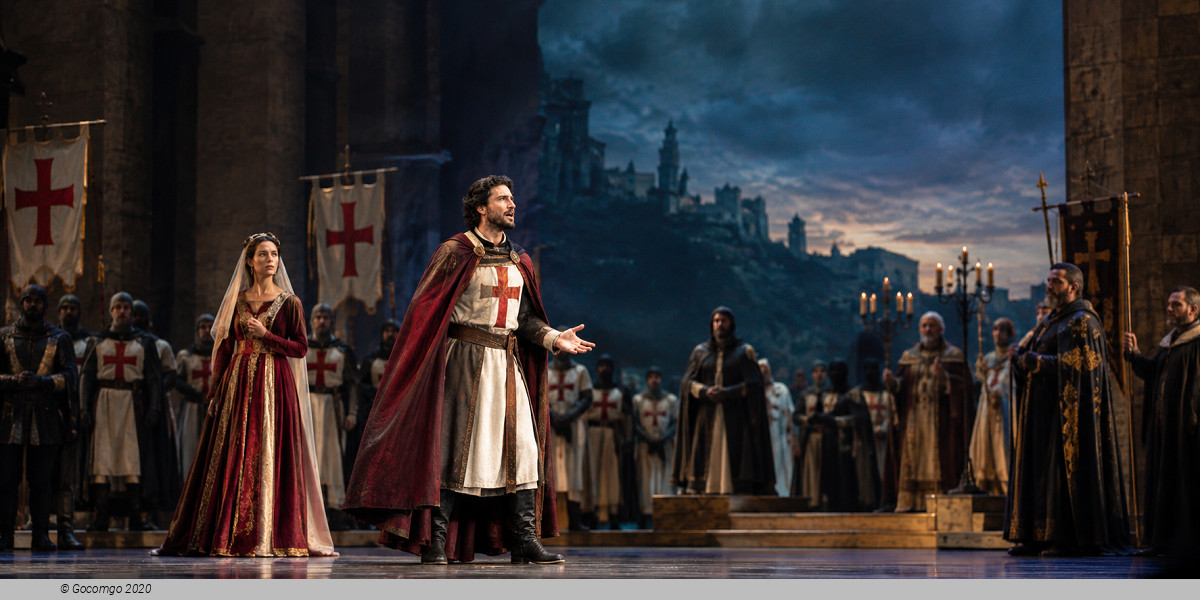
The people of Aroldo's castle welcome him home from the Crusades. Then Mina enters distraught and remorseful, confessing her adultery (ciel, ch'io respiri / "Heavens, let me breathe"). She prays as Briano and Aroldo enter, the latter concerned about his wife's state of mind given that she had been his inspiration during the long period that he was away fighting the Saracens. He explains that Briano, now his faithful companion, had saved his life. Taking her hand, he is surprised to see that she is not wearing his mother's ring, which she had received upon his mother's death. He demands to know where it is, and tries to get to the bottom of her state of mind but they are interrupted by the return of Briano with news of the arrival of guests. Both men leave.
Mina's father, Egberto, enters and observes her writing a letter. Already suspicious of what he believes has been going on between Godvino and Mina, he demands to know if she is writing to Godvino. Snatching away the unfinished letter, he reads the words addressed not to Godvino but to Aroldo - "I am no longer worthy of you" - and realizes that he was not mistaken. He begins to demand that Mina keep silent and ensure Aroldo's continued love (Duet: Dite che il fallo a tergere / "You mean that your heart lacks the strength to wipe away your guilt?") while she further resists. Again, demanding that she obey him, he continues to make his demands: (Duet: Ed io pure in faccia agl'uomini / "And must I smother my rage....Must I conquer my shame?"). Finally, Egberto repeats his demands that she relent: it is his will, it is her duty as a wife, she must stop crying, and no one must suspect anything. She appears to relent (Duet: Or meco venite, il pianto non vale / "Come with me now, weeping will not help you").
Scene 2: A suite of rooms in the castle
Furtively, Godvino enters the room while a party is progressing in interior rooms. He laments that Mina has not contacted him in any way and, in a pre-arranged plan, leaves a letter within the pages of a book to which he has a key. However, unseen by Godvino, Briano has entered and observes Godvino's actions. He grows suspicious: "a friend of Aroldo?", he wonders. The guests flow into the room and Godvino is absorbed within the group. They all express their joy at Aroldo's return. Briano approaches Aroldo and explains what he has seen, pointing across the room to Enrico, Mina's cousin, as the one who planted the letter and who then picked up the book. But he is amongst the group and is dressed in the same way as Godvino, so there is some confusion. Suspicion falls on Enrico as Aroldo reveals that his honour has been betrayed. He tells of a similar situation in Palestine: Aria: Vi fu in Palestina / "In Palestine there was once a certain man....", and confronts Mina, since he knows that she has a key to the book and he believes that it too contains a secret letter. Mina's attempts to stall fail, and Aroldo breaks open the locked book and a letter drops from it to the floor. Quickly stepping forward, Egberto picks it up stating that no one shall see it. Aroldo is angry and Mina defends her father. Knowing the real culprit, Egberto confronts Godvino and demands that they meet in the churchyard.
Act 2
The castle cemetery
Mina is alone in the churchyard; she despairs of her situation (Aria: (Oh Cielo, dove son'io? / "O Heaven. Where am I?"). When Godvino enters, she demands to be left alone and her ring be returned. He declares his love and insists upon staying to defend her while she proclaims that she hears her mother's voice coming from her tomb (Aria: Ah, dal sen di quella tomba / "Ah, from the depths of that tomb there echoes a sinister trembling"). Egberto comes across the couple, sends Mina away, and then confronts Godvino, offering him the choice of two proffered swords. Godvino refuses to take one. The older man continues to press him ("Are you dead to any sense of honour?"), accusing him of cowardice and stating that he will reveal him to be a bastard. At that remark, Godvino accepts the challenge and the two men fight until interrupted by the arrival of Aroldo. Stating that "I speak in the name of God", Aroldo tries to force the two men to stop their fighting. In disarming him, he takes Godvino's hand only to have Egberto question how Aroldo can take the hand of the very man who has betrayed him. With Mina's return, Aroldo finally realizes the truth (Aria: Ah no! è impossibile / "Ah no! It is impossible. Tell me at least that I have been mistaken"). Finally, Egberto insists that Aroldo must punish the right person and not Mina, and Aroldo attempts to return Godvino's sword and commence fighting him. Godvino refuses. With Briano's arrival and his attempts to calm his friend ("my heart has lost everything", Aroldo cries, while the chorus of praying parishioners can be heard coming from the church), all join in a plea for forgiveness. Aroldo collapses.
Act 3
An anteroom in Egberto's castle
Egberto feels dishonoured and he regrets not being able to take his revenge, since Godvino has fled from the cemetery, taking Mina with him. He puts up his sword: O spada dell'onor / "O sword of honour...begone from me". Regretting that he has lost a daughter (Mina, pensai che un angelo / "Mina, I thought, through you, heaven had sent me an angel, a ray of pure love"), he writes a brief farewell note to Aroldo, and is about to take poison when Briano enters looking for Aroldo. He tells Egberto that Godvino has been apprehended and will be brought to the castle. Taking up his sword again, Egberto expresses his joy that one of the two of them will soon die: Oh gioia inesprimibile / "Oh inexpressible joy..." He leaves.
Aroldo enters with Godvino. The two men sit down to talk and Aroldo asks his rival what he would do if Mina were free. Mina is then summoned and Godvino is instructed to conceal himself and listen to the couple's conversation. Aroldo explains to Mina that they need to talk since he will be leaving that evening and that they must part (Opposto è il calle che in avvenire / "In the future, our lives must follow opposite paths"). He adds that she can redeem herself from dishonour by marrying the man who has captured her heart, and he presents her with a divorce paper to sign. She does so, declaring that they are free of each other. But she states that, in spite of everything, she could not be another man's wife and that she will always love Aroldo. Questioning her, he asks if she had been tricked into entering into the relationship by Godvino. When the answer is "yes", Aroldo swears that Godvino must die, indicating that her seducer is in the next room. Just then, Egberto bursts in, his sword covered in blood, and he declares that Godvino is dead. Briano leads Aroldo off to church while Mina cries out there has been no forgiveness for her sin.
Act 4
A valley close to Loch Lomond
At sunset, a group of shepherds, huntsman and reapers have gathered on the banks of the Loch. As they leave, Aroldo and Briano appear, Aroldo confessing that he still loves Mina. The men pray as a storm begins and it drives the countryfolk back to the lake. A boat barely survives the storm and it arrives on land carrying Mina and Egberto, now shipwrecked. Seeking shelter, Egberto knocks on a stranger's door and, to his surprise, Aroldo appears, but Aroldo is angry, since he and Briano have fled to this remote place with no expectation of ever meeting Mina or her father again. In spite of Aroldo's objections, Egberto pleads with him to accept Mina as his daughter, if not as her husband. Mina tries to calm her father (Taci, mio padre, calmati / "Be silent, father, calm yourself"). In the hope of obtaining forgiveness (in a trio involving Egberto, Mina and Aroldo) she begs for a "last word" with Aroldo (Allora che gl'anni / "When the weight of years..."). Then Briano steps forward. He proclaims the often-quoted words from the Bible: "Let him who is without sin cast the first stone". Aroldo is reduced to tears and, with the pleadings of both Briano and Egberto, he forgives his wife. As all exclaim "Let the divine will triumph", the couple embraces, and Mina and Aroldo are reunited.



 Str. G. Garibaldi, 16 / a