Rome, 1800: Cesare Angelotti has succeeded in escaping from the Castel Sant’Angelo, the notorious state prison, where he had been held as a political prisoner. He seeks refuge in the church of Sant’Andrea della Valle where he encounters his friend, the painter Mario Cavaradossi. Suddenly the latter’s lover, opera singer Floria Tosca, appears: she is suspicious because the church door was locked, and jealous because Cavaradossi’s portrait of the Madonna bears a striking resemblance to a real-life lady. However, Cavaradossi is able to calm her down. Tosca leaves. Alone again, Angelotti and Cavaradossi work on plans for his escape – but then a cannon fires, signalling that Angelotti’s escape has been noticed. The two of them leave the church. While the choir rehearses, Scarpia, the chief of police, bursts in and has his men search the church for the fugitive Angelotti. Tosca comes back into the church as well. Scarpia knows about the relationship between her and Cavaradossi and decides to make her jealous. He succeeds. Some time later he lures Tosca to his apartment in the Palazzo Farnese where Cavaradossi, who has been recaptured, is also brought to him. Cavaradossi is to be tortured until Tosca reveals Angelotti’s hiding-place. She does so, provoking Cavaradossi’s anger. Scarpia orders Cavaradossi’s execution unless Tosca gives herself to him, in which case he will let the painter go. Tosca agrees and Scarpia promises that the execution will only be staged. Tosca also manages to negotiate a safe-conduct pass from Scarpia that will allow her and Cavaradossi to leave Rome. As he is writing the document she stabs him. She then washes her hands, takes the letter from Scarpia’s lifeless fingers, tidies her hair and leaves. At the Castel Sant’Angelo she tells Cavaradossi that the execution will only be faked and gives him his instructions: after the first shot is fired he should fall down and lie still. But the firing squad is in fact genuine: Scarpia gave orders that Cavaradossi is really to be executed. In the meantime the police have discovered Scarpia’s body and are now after Tosca. When she realises that Cavaradossi is really dead she dashes up to the top of the Castel Sant’Angelo and plunges to her death.
Act 1
Inside the church of Sant'Andrea della Valle
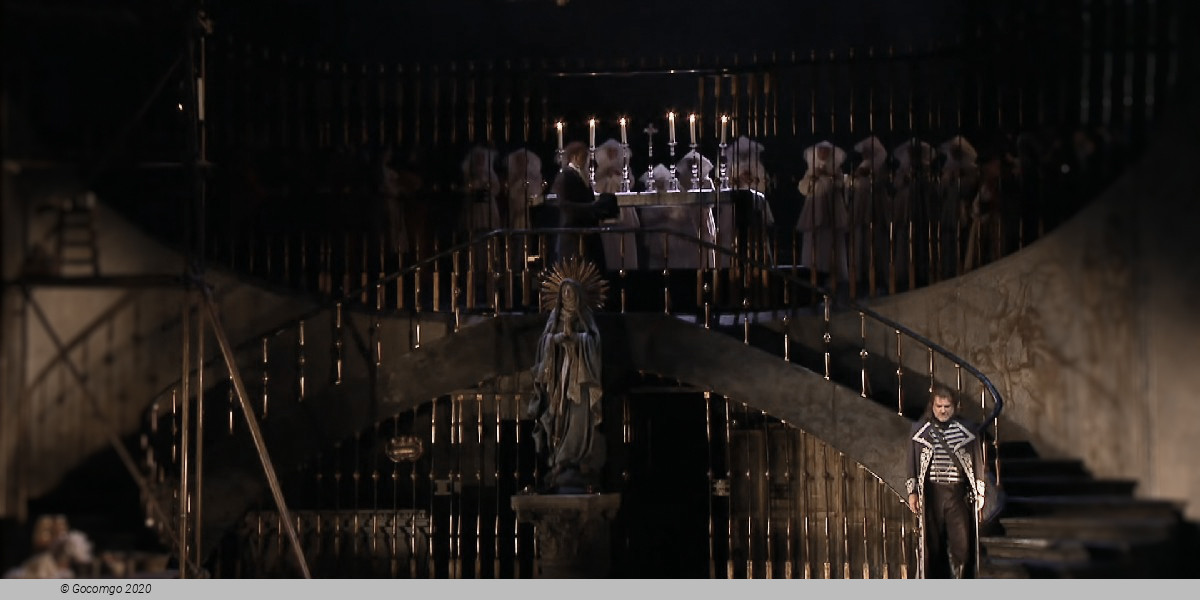
Scene depicting a church interior with high stained-glass windows and heavy ornamental columns. The central figure is a high dignatory around whom several figures are kneeling, while in the background can be seen the tall pikes of the Swiss Guard.
Cesare Angelotti, former consul of the Roman Republic and now an escaped political prisoner, runs into the church and hides in the Attavanti private chapel – his sister, the Marchesa Attavanti, has left a key to the chapel hidden at the feet of the statue of the Madonna. The elderly Sacristan enters and begins cleaning. The Sacristan kneels in prayer as the Angelus sounds.
The painter Mario Cavaradossi arrives to continue work on his picture of Mary Magdalene. The Sacristan identifies a likeness between the portrait and a blonde-haired woman who has been visiting the church recently (unknown to him, it is Angelotti's sister the Marchesa). Cavaradossi describes the "hidden harmony" ("Recondita armonia") in the contrast between the blonde beauty of his painting and his dark-haired lover, the singer Floria Tosca. The Sacristan mumbles his disapproval before leaving.
Angelotti emerges and tells Cavaradossi, an old friend who has republican sympathies, that he is being pursued by the Chief of Police, Baron Scarpia. Cavaradossi promises to assist him after nightfall. Tosca's voice is heard, calling to Cavaradossi. Cavaradossi gives Angelotti his basket of food and Angelotti hurriedly returns to his hiding place.
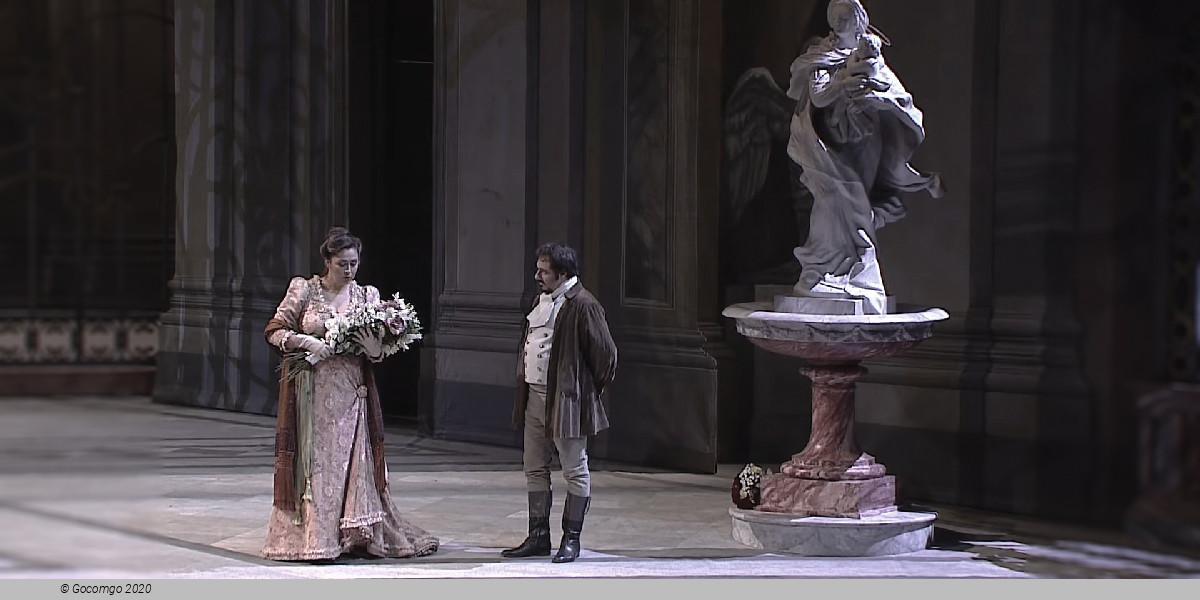
Tosca enters and suspiciously asks Cavaradossi what he has been doing – she thinks that he has been talking to another woman. Cavaradossi reassures her and Tosca tries to persuade him to take her to his villa that evening: "Non la sospiri, la nostra casetta" ("Do you not long for our little cottage"). She then expresses jealousy over the woman in the painting, whom she recognises as the Marchesa Attavanti. Cavaradossi explains the likeness; he has merely observed the Marchesa at prayer in the church. He reassures Tosca of his fidelity and asks her what eyes could be more beautiful than her own: "Qual'occhio al mondo" ("What eyes in the world").
After Tosca has left, Angelotti reappears and discusses with the painter his plan to flee disguised as a woman, using clothes left in the chapel by his sister. Cavaradossi gives Angelotti a key to his villa, suggesting that he hide in a disused well in the garden. The sound of a cannon signals that Angelotti's escape has been discovered. He and Cavaradossi hasten out of the church.
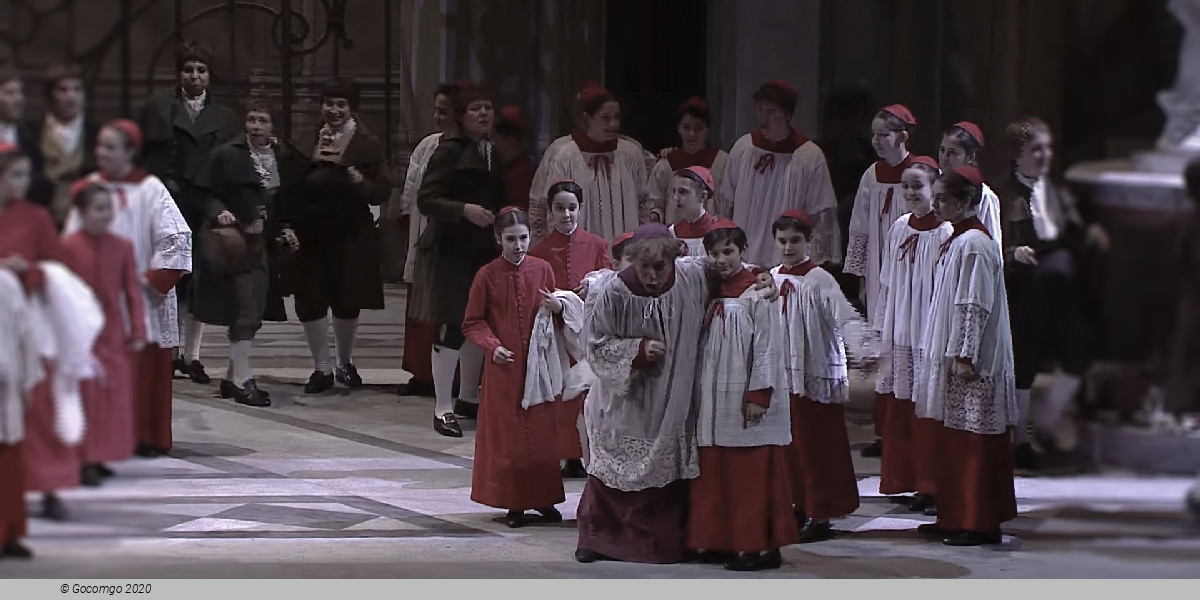
The Sacristan re-enters with choristers, celebrating the news that Napoleon has apparently been defeated at Marengo. The celebrations cease abruptly with the entry of Scarpia, his henchman Spoletta and several police agents. They have heard that Angelotti has sought refuge in the church. Scarpia orders a search, and the empty food basket and a fan bearing the Attavanti coat of arms are found in the chapel. Scarpia questions the Sacristan, and his suspicions are aroused further when he learns that Cavaradossi has been in the church; Scarpia mistrusts the painter, and believes him complicit in Angelotti's escape.
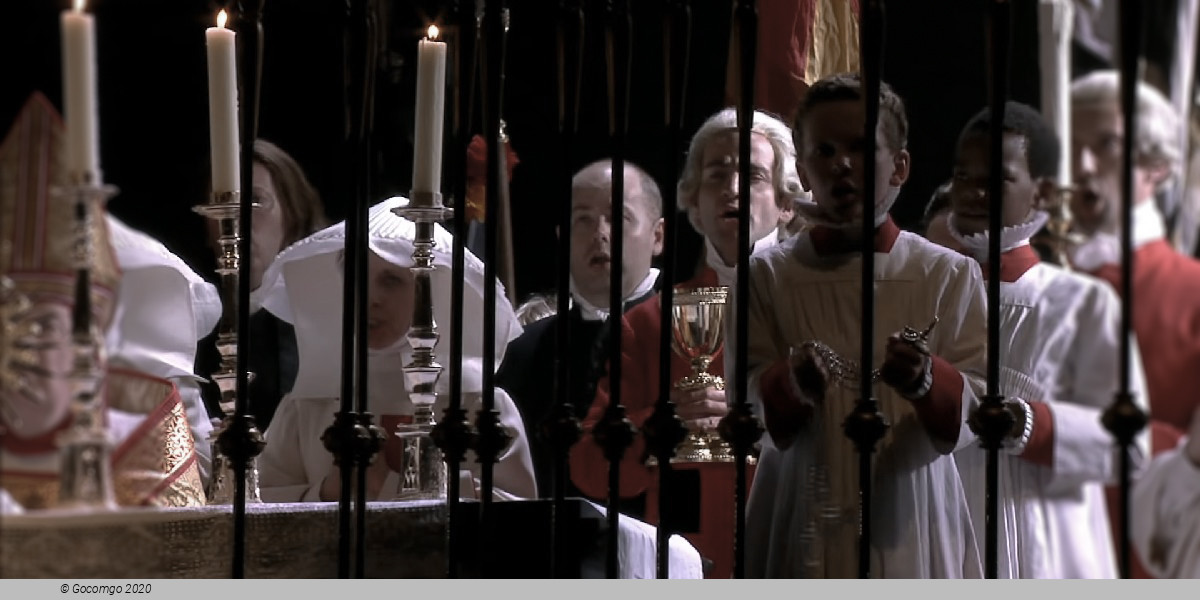
When Tosca arrives looking for her lover, Scarpia artfully arouses her jealous instincts by implying a relationship between the painter and the Marchesa Attavanti. He draws Tosca's attention to the fan and suggests that someone must have surprised the lovers in the chapel. Tosca falls for his deceit; enraged, she rushes off to confront Cavaradossi. Scarpia orders Spoletta and his agents to follow her, assuming she will lead them to Cavaradossi and Angelotti. He privately gloats as he reveals his intentions to possess Tosca and execute Cavaradossi. A procession enters the church singing the Te Deum; exclaiming 'Tosca, you make me forget even God!', Scarpia joins the chorus in the prayer.
Act 2
The body of a man lies supine, with a woman, crucifix in hand, kneeling over him. A candle is placed to each side of his head.
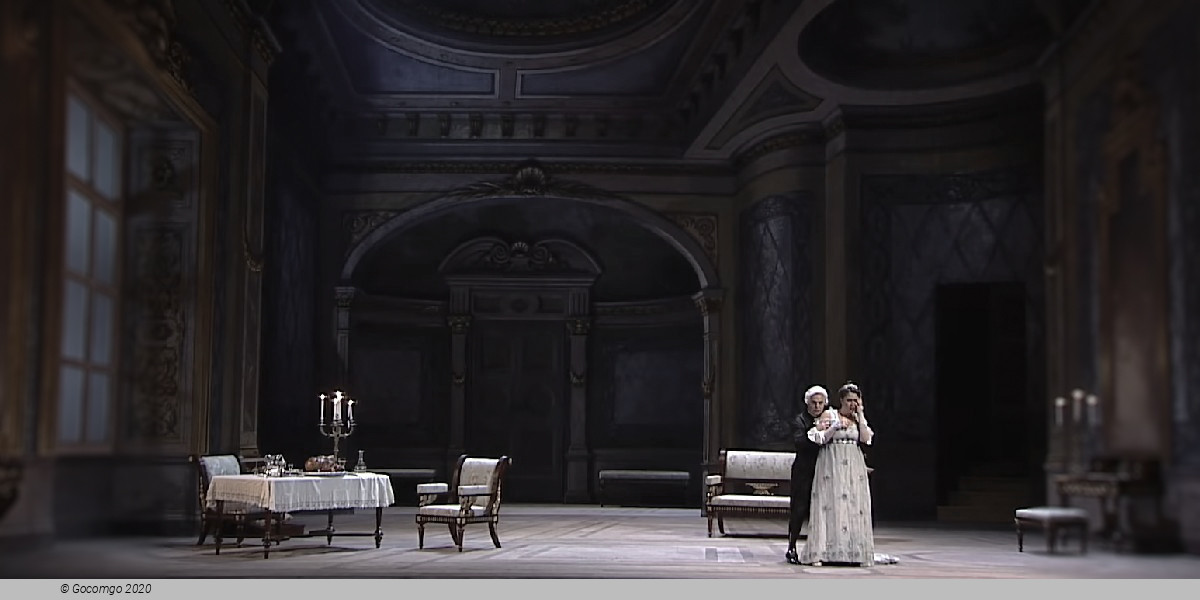
Scarpia's apartment in the Palazzo Farnese, that evening
Scarpia, at supper, sends a note to Tosca asking her to come to his apartment, anticipating that two of his goals will soon be fulfilled at once. His agent, Spoletta, arrives to report that Angelotti remains at large, but Cavaradossi has been arrested for questioning. He is brought in, and an interrogation ensues. As the painter steadfastly denies knowing anything about Angelotti's escape, Tosca's voice is heard singing a celebratory cantata elsewhere in the Palace.
She enters the apartment in time to see Cavaradossi being escorted to an antechamber. All he has time to say is that she mustn't tell them anything. Scarpia then claims she can save her lover from indescribable pain if she reveals Angelotti's hiding place. She resists, but the sound of screams coming through the door eventually breaks her down, and she tells Scarpia to search the well in the garden of Cavaradossi's villa.
Scarpia orders his torturers to cease, and the bloodied painter is dragged back in. He's devastated to discover that Tosca has betrayed his friend. Sciarrone, another agent, then enters with news: there was an upset on the battlefield at Marengo, and the French are marching on Rome. Cavaradossi, unable to contain himself, gloats to Scarpia that his rule of terror will soon be at an end. This is enough for the police to consider him guilty, and they haul him away to be shot.
Scarpia, now alone with Tosca, proposes a bargain: if she gives herself to him, Cavaradossi will be freed. She is revolted, and repeatedly rejects his advances, but she hears the drums outside announcing an execution. As Scarpia awaits her decision, she prays, asking why God has abandoned her in her hour of need: "Vissi d'arte" ("I lived for art"). She tries to offer money, but Scarpia isn't interested in that kind of bribe: he wants Tosca herself.
Spoletta returns with the news that Angelotti has killed himself upon discovery, and that everything is in place for Cavaradossi's execution. Scarpia hesitates to give the order, looking to Tosca, and despairingly she agrees to submit to him. He tells Spoletta to arrange a mock execution, both men repeating that it will be "as we did with Count Palmieri," and Spoletta exits.
Tosca insists that Scarpia must provide safe-conduct out of Rome for herself and Cavaradossi. He easily agrees to this and heads to his desk. While he's drafting the document, she quietly takes a knife from the supper table. Scarpia triumphantly strides toward Tosca. When he begins to embrace her, she stabs him, crying "this is Tosca's kiss!" Once she's certain he's dead, she ruefully says "now I forgive him." She removes the safe-conduct from his pocket, lights candles in a gesture of piety, and places a crucifix on the body before leaving.
Act 3
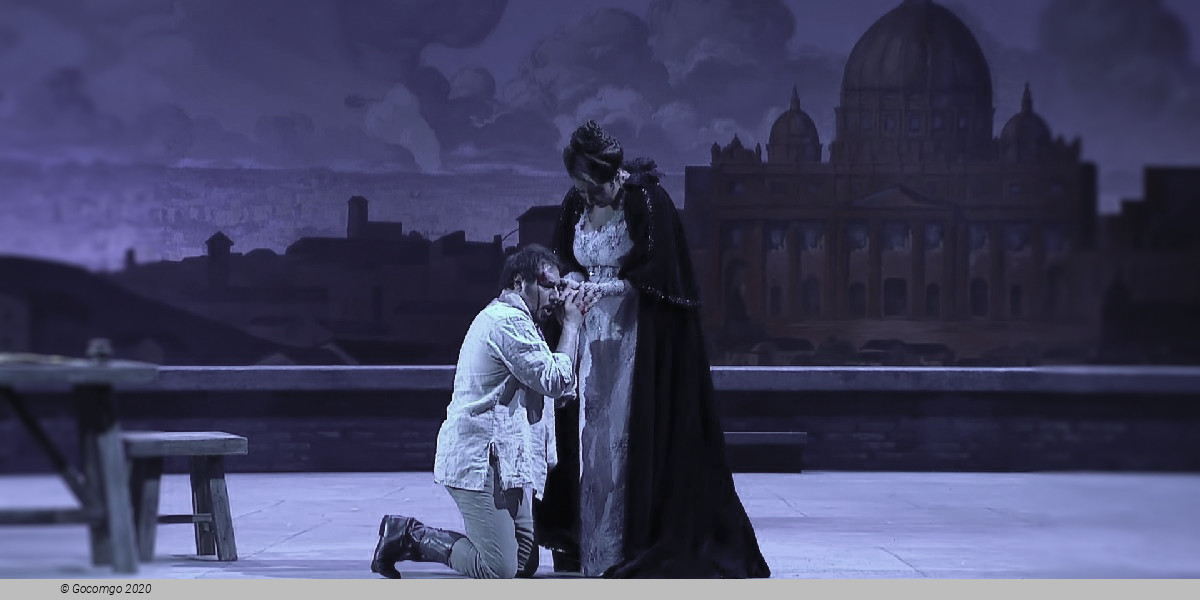
The upper parts of the Castel Sant'Angelo, early the following morning
Roman panorama showing, centre, an arched bridge over a river with a domed building in the distance. To the right of the bridge is a large circular fortress.
A shepherd boy is heard offstage singing (in Romanesco dialect) "Io de' sospiri" ("I give you sighs") as church bells sound for matins. The guards lead Cavaradossi in and inform him that he has one hour to live. He declines to see a priest, but asks permission to write a letter to Tosca. He begins to write, but is soon overwhelmed by memories: "E lucevan le stelle" ("And the stars shone").
Tosca enters and shows him the safe-conduct pass she's obtained, adding that she has killed Scarpia and that the imminent execution is a sham. Cavaradossi must feign death, after which they can flee together before Scarpia's body is discovered. Cavaradossi is awestruck by his gentle lover's courage: "O dolci mani" ("Oh sweet hands"). The pair ecstatically imagines the life they will share, far from Rome. Tosca then anxiously coaches Cavaradossi on how to play dead when the firing squad shoots at him with blanks. He giddily promises he'll fall "like Tosca in the theatre."
Cavaradossi is led away, and Tosca watches with increasing impatience as the execution is prepared. The men fire, Cavaradossi falls, and Tosca exclaims "Ecco un artista!" ("What an actor!"). When the soldiers have all left, she hurries towards Cavaradossi, only to find that Scarpia betrayed her: the bullets were real. Heartbroken, she clasps her lover's lifeless body and weeps.
The voices of Spoletta, Sciarrone, and the soldiers are heard, shouting that Scarpia is dead and Tosca has killed him. As the men rush in, Tosca rises, evades their clutches, and runs to the parapet. Crying "O Scarpia, Avanti a Dio!" ("O Scarpia, we meet before God!"), she flings herself over the edge to her death.




 Linke Wienzeile 6